Throughout India’s history, ethics and morality have epitomized public conduct. The inseparability of ethics and politics was evident in ancient Indian politics. This ethical foundation was passed to national leaders, notably visible during the freedom movement spearheaded by Mahatma Gandhi. His embodiment of moral values set a precedent, advocating integrity in public life. However, recent times have witnessed apprehensions about the declining ethical standards within India’s political sphere, signaling a system under strain.
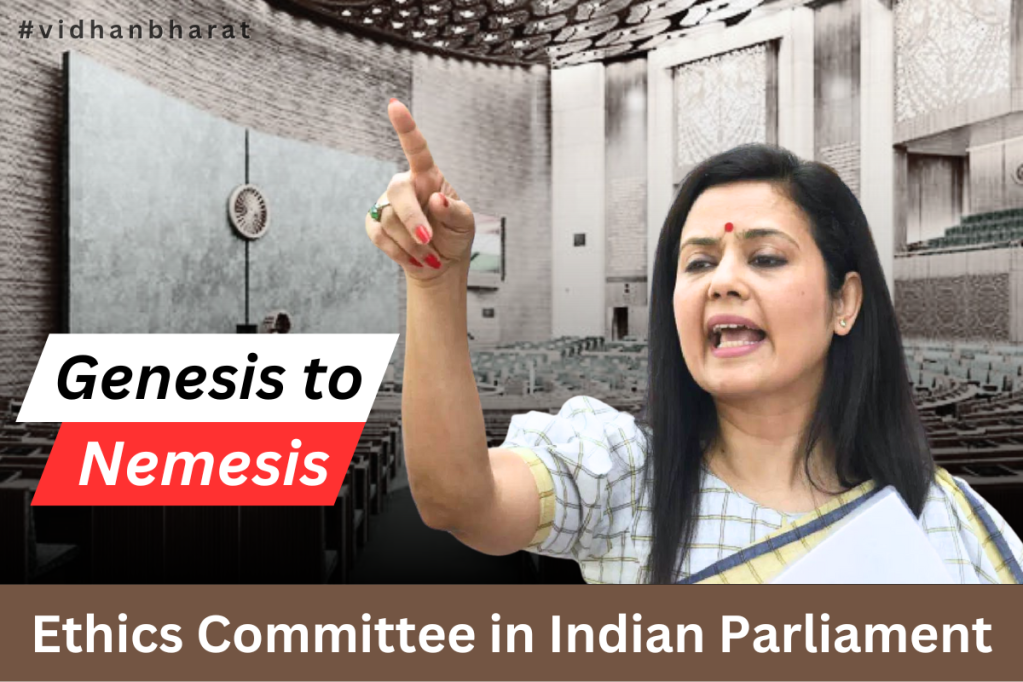
The recent expulsion of Mahua Moitra, TMC MP for Krishnanagar, from the Lok Sabha for the cash-for-query scandal highlights the imperative for ethical conduct in public life.
This blog delves into the historical background of the Ethics Committee, its operational mechanisms, and past instances of comparable controversies, shedding light on the ongoing discourse surrounding ethical standards in the public sphere.
Genesis:
In 1996, the Business Advisory Committee of Rajya Sabha determined that ethics-related issues should be deliberated by the leaders of parties within the House. Acting upon the initiative of I. K. Gujral, a meeting took place in 1996, involving leaders of parties and groups in Rajya Sabha to address the matter. Subsequently, in 1997, the General Purposes Committee of Rajya Sabha reviewed the issue and, after careful consideration, opted for the establishment of an internal mechanism within the House. This internal mechanism would function as a self-regulatory body overseeing the conduct of Rajya Sabha members. The Committee empowered the Chairman of Rajya Sabha to form an Ethics Committee tasked with supervising the ethical behavior of its members. 1
On March 4, 1997, the Chairman of Rajya Sabha officially constituted the Ethics Committee. This marked the inception of the first such committee by any legislative body in India, entrusted with the responsibility of monitoring the conduct of members and examining cases related to ethical and other misconduct referred to it. 2
Regarding the Lok Sabha, the Committee of Privileges, during the 11th Lok Sabha, established a Study Group on January 31, 1997, tasked with examining Parliamentary Privileges, Ethics, and related matters. This Study Group conducted visits to Australia, the UK, and the United States to investigate the approaches adopted in these countries regarding ethics and standards of conduct for Members. Upon its return, the Study Group drafted a report, comprehensively covering various aspects of Parliamentary Privileges, with a particular focus on ethical considerations. 3
The Committee also participated in a symposium at the Presiding Officers Conference in Shimla on October 23, 1997, addressing the topic ‘Need for Constitution of the Ethics Committees in Legislatures in India.’ In the 13th Lok Sabha, the unfinished agenda from the 11th Lok Sabha was brought to the attention of the Committee of Privileges. Without negating the earlier recommendations of the 11th Lok Sabha, the Committee recommended the formation of a distinct Ethics Committee in the Lok Sabha. 4
In line with this recommendation, the Speaker of the 13th Lok Sabha, the late Shri G.M.C. Balayogi constituted the first Ethics Committee in the Lok Sabha on May 16, 2000. 5
Composition & Functions:
In Rajya Sabha, Chapter XXIV of the Rajya Sabha Conduct Rules deals with the Committee on Ethics. According to Rule 287, “The Chairman shall, from time to time, nominate a Committee on Ethics consisting of ten members.” 6 Additionally, Rule 290 outlines the functions of the committee.
This includes the responsibility to formulate a Code of Conduct for members, scrutinizing cases related to alleged breaches of the Code of Conduct by members, and overseeing the moral and ethical conduct of members.
In the Lok Sabha, the functions of the Committee on Ethics are regulated by Rule 316-A of the Lok Sabha Conduct Rules, which establishes an Ethics Committee comprising “not more than fifteen members.” 7 The Speaker is responsible for appointing the members, and they serve a term of no more than one year. The functions of the Lok Sabha Ethics Committee mirror those of its Rajya Sabha counterpart.
Nemesis:
The recent expulsion of Mahua Moitra from the Ethics Committee is not an unprecedented occurrence. Back in 2005, both Houses passed resolutions to expel 10 Lok Sabha MPs and 1 Rajya Sabha MP. These members were alleged to have accepted money in exchange for posing questions in Parliament. The Lok Sabha’s decision was grounded in the findings of a special committee, initiated by the Speaker and led by P K Bansal, the MP for Chandigarh. Meanwhile, the Rajya Sabha addressed the complaint through its Ethics Committee. 8
In the aforementioned case, the evidence was unequivocal, stemming from a sting operation. However, in the recent incident involving TMC MP Mahua Moitra, 3 critical flaws have been pointed out by the experts and herself.
Firstly, the Ethics committee overlooked the contradiction between the accusations presented by Jai Anant Dehadrai, whose complaint prompted BJP MP Nishikant Dubey to bring the matter to the speaker, and Darshan Hiranandani, who subsequently substantiated many of Dehadrai’s claims in an affidavit to the ethics committee. 9
Secondly, the Ethics Committee acknowledged the bribery allegations against Moitra, yet failed to address discrepancies in the information provided by Dehadrai and Hiranandani on this matter. 10
Finally, despite Ms. Moitra’s request, the Ethics Committee abstained from cross-examining Hiranandani. 11
Final Word:
It is undeniable that there has been a widespread decline in moral values across various spheres of life. In such circumstances, the role of people’s representatives, who bear significant responsibility for steering the system, becomes crucial. The recent incident has underscored that, although there may be numerous approaches to ensure integrity in public life, a self-disciplining mechanism seems to be the most effective within an institution like Parliament.
References:
- Ethics Committee – An Introduction. Rajya Sabha Secretariat. For more details visit https://cms.rajyasabha.nic.in/UploadedFiles/ElectronicPublications/ethics_committee.pdf
- Committee on Ethics. Lok Sabha Secretariat. For more details visit https://loksabhadocs.nic.in/LSSCOMMITTEE/Ethics/Introduction/Introduction%20Ethics%20Committee.pdf
- Rules of Procedure and Conduct of Business in the Council of States. Rajya Sabha Secretariat. For more details visit https://cms.rajyasabha.nic.in/UploadedFiles/LegislativeSection/LegislativeRules/English_2052022english_3092021rules_pro.pdf
- Pathak, V. (2023). Lok Sabha’s Ethics Committee: its history, constitution, and members. The Indian Express. For more details visit https://indianexpress.com/article/explained/ls-ethics-committee-its-constitution-members-8999613/
- Mahaprashasta, A. A. (2023). (At least) Three Critical Flaws in the Ethics Committee Report on Mahua Moitra. The Wire. For more details visit https://thewire.in/politics/at-least-three-critical-flaws-in-the-ethics-committee-report-on-mahua-moitra



 Vidhan Bharat
Leave a comment