As Dr. S. Jaishankar, Minister of External Affairs of India, said in his book ‘The India Way’:
“This is a time for us to engage America, manage China, cultivate Europe, reassure Russia, bring Japan into play, draw neighbors in, extend the neighborhood, and expand traditional constituencies of support.” This line sincerely indicates the India’s current approach to foreign policy. It’s interesting to look back on the journey of India’s foreign policy from a historical perspective of continuity. In this context, he Gujral Doctrine has a significant place in India’s foreign policy.
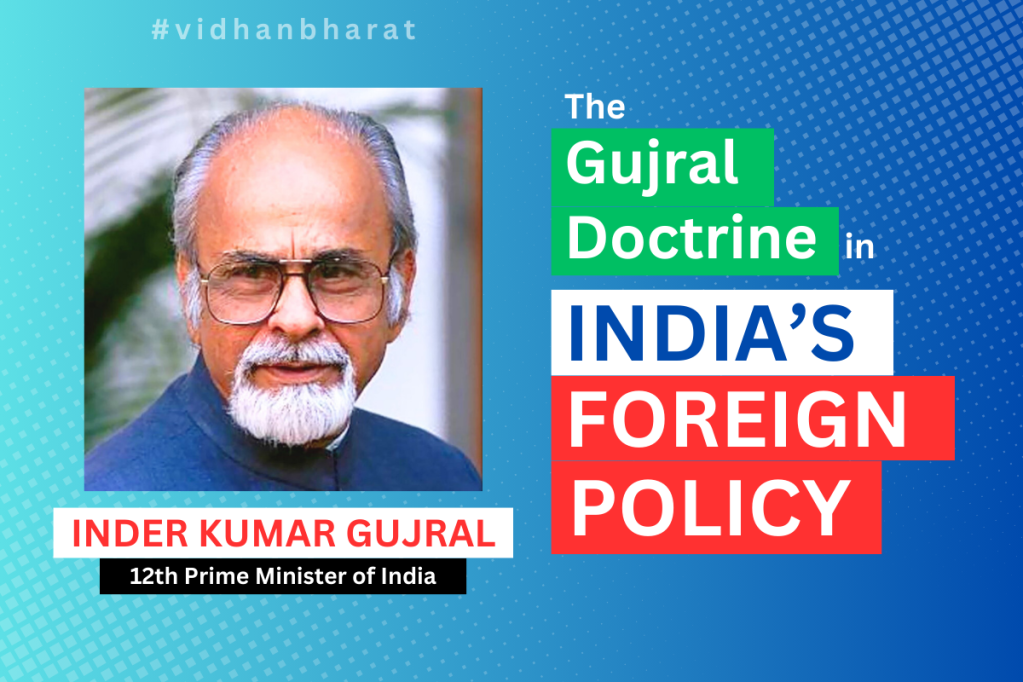
On 30th November 2023, the 11th death anniversary of India’s 12th Prime Minister Inder Kumar Gujral was marked. We can say that he became a real-life accidental prime minister in 1997 after the resignation of the then Prime Minister Deve Gowda. Before becoming PM, I.K. Gujral was the Union Minister of Foreign Affairs. During this period, he introduced a unique foreign policy approach that has come to be known as the Gujral Doctrine.
The Gujral Doctrine is based on strengthening trust and cooperation in India’s neighborhood. I.K. Gujral gave the following five basic principles of the Gujral Doctrine while delivering the speech in September 1996 at London’s Chatham House:
1) Instead of seeking reciprocity, India offers assistance wholeheartedly to its neighboring countries.
2) South Asian nations won’t tolerate the use of their territory to harm the interests of another country in the region.
3) None will interfere in the internal affairs of another.
4) All South Asian Countries must respect each other’s territorial integrity and sovereignty.
5) Nations will resolve all their disputes through peaceful bilateral negotiations.
Furthermore, it also believes that India’s significant size and population naturally position it as a key player in South and South-East Asia.
While talking about the impact of the Gujral Doctrine, this approach to foreign policy helped strengthen trust and cooperation in India’s neighborhood. The resolution of the water-sharing dispute with Bangladesh came in just three months in 1996-97 as a result of this approach. India got Bhutanese consent for a canal project to increase water flow to the Ganga. This almost occurred simultaneously with the treaty with Nepal for taming the Mahakali River for the generation of hydel power. It was followed by agreements with Sri Lanka to build up development cooperation. Likewise, it guided the start of a composite dialogue with Pakistan. In this manner, the Gujral Doctrine had played an active role in India’s foreign policy at the end of the 20th century, specially to sort out issues of disputes with its neighboring countries and promote cooperation.
However, the Gujral Doctrine was criticized for its lenient approach towards Pakistan as well as its failure to address bilateral issues. Here, international affairs expert C. Raja Mohan’s words fit properly: “Neither tough nor nice policies will address India’s regional challenges, which are deeply structural.” Even further, he noted that “Regions are not static; their geographic shape, political structure, and economic orientation evolve over time.” The Doctrine was criticized for positioning India as a needy power and for projecting soft image of the country. This, however, is not entirely true. For example, in 1996, the United Nations adopted the Comprehensive Nuclear Test Ban Treaty. Despite global pressure, I K Gujral firmly rejected signing the Comprehensive Test Ban Treaty (CTBT).
Looking forward, in the present scenario, we can observe that globally many countries are facing war-type situations; simultaneously, developed countries are giving financial assistance to underdeveloped countries, and in return, they are trying to encroach on the sovereignty of those nations. Meanwhile, to tackle these challenges, we need a practical approach towards foreign policy like the Gujral Doctrine, which is situation-based. We can remember an enlightening quote of I.K. Gujral, “We are a huge country, with different linguistic, religious, and cultural backgrounds. Despite our difficulties, we have held together, and that too democratically, which is something few others can boast about. In that sense, we are a great role model.”




 Vidhan Bharat
Leave a comment