“It is not enough to win a war; it is more important to organize peace”
– Aristotle.
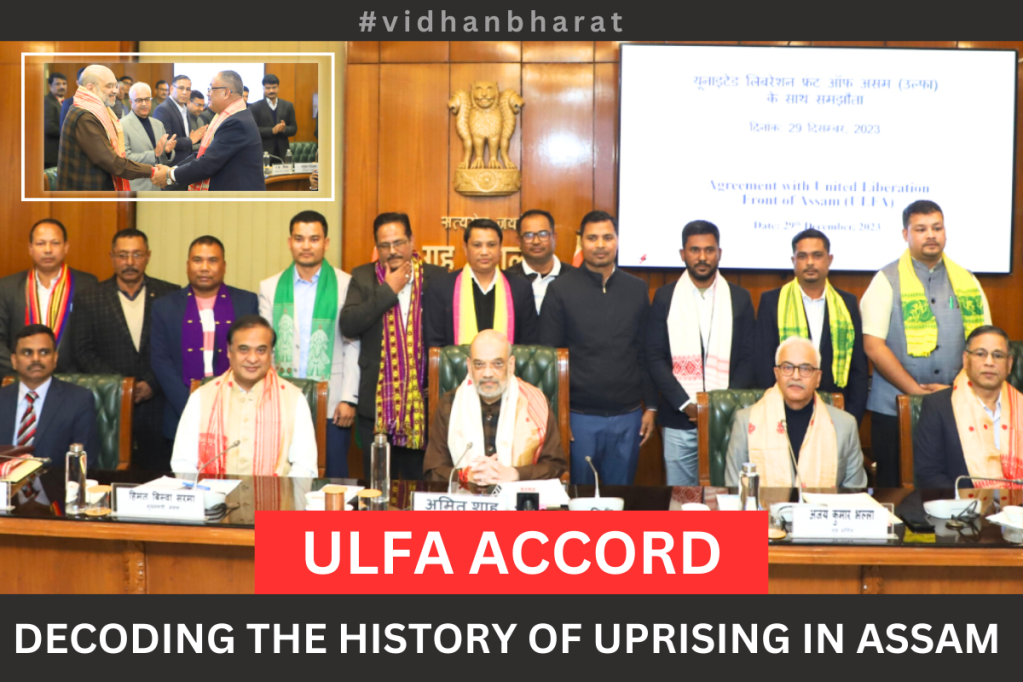
Recently we celebrated the Aazadi Ka Amrit Mohotsav to commence 75th years of independence. We were indeed freed from British Colonial Rule in 1947, but were we successful in establishing peace IN EVERY corner of the country? Thankfully, Iron Man of India Sardar Vallabhbhai Patel worked effortlessly to integrate 565 princely states into the Union of India. However, northeast part of India has been facing insurgency since independence. Recently, the United Liberation Front of Asom (ULFA) signed a tripartite deal with the State Government of Assam and the Government of India.
First of all, let’s see the history of Assam. According to ancient history, Samudragupta’s inscription on the Allahabad pillar mentioned the name of Assam as a “Kamarupa”. Further, in the medieval period, the Ahom Dynasty was established by Ahoms who came to Assam from Mongolia. After six hundred years, Ahom Daynesty’s rule ended with the treaty of Yandaboo in 1826 with the British East India Company. In this way, Assam became a separate province of Britishers. We can observe that the transition of Ahom to Assam is a product of anglicization. However, Assam became a constituent state of India in 1950 after independence from the British colonial rule.
Now it’s important to understand the root cause of insurgency in the northeast part of India (Especially in Assam). Lt Col Vivek Chadha in his book ‘Low Intensity Conflicts in India’ mentioned that “There are two dimensions of the uprising in Assam. The first is that the majority of the Ahom population wishes to secede from the Indian Union. This secessionist movement had gained initial popularity by fighting on emotive issues, such as illegal immigration and economic deprivation. The second dimension of the uprisings has been spearheaded by tribal groups, such as the Bodos, Karbis, Hmars, Rabhas, Mishings, and Tiwis, who want autonomy and statehood for the regions of Assam they occupy. The primary reason underlying their demand is that they have been neglected within Assam.” This situation gave rise to the insurgency.
All Assam Students Union (AASU) and the All Assam Gana Sangram Parishad (AAGSP) popularized the Assam Movement from 1979 to 1985 against illegal migration in Assam from Bangladesh. This movement was called the ‘Assam Accord’ which was signed by agitators from Assam and the Government of India. However, the United Liberation Front of Asom (ULFA) was formed in 1979 by young radicals in Assam in response to the same issue as we discussed above. ULFA members were not satisfied with the ‘Assam Accord’ hence they started an armed struggle against the government of India. ULFA members received external support from neighbouring countries which includes Pakistan’s ISI.
In response to this, Indian Government launched ‘Operation Bajrang’ to neutralize ULFA. In 1990, the conflict went beyond control and GOI imposed President Rule as well as the Armed Forces Special Powers Act (AFSPA) in Assam. As a result, ULFA faced internal division as one faction of it called ‘SULFA’ surrendered to the Government. SULFA not only surrendered but also helped the government to secretly haunt down the ULFA members. In 2005, ULFA members agreed for peace talks with the government but unfortunately discussion was not successful and ULFA continued their violence. Again in 2008 and 2012, some ULFA commanders agreed to peace talks which resulted in a major split in ULFA. Finally, in 2012, the Pro Talk faction submitted a 12-point charter of demands which led to a present tripartite peace agreement.
This tripartite peace agreement is a significant step towards establishing peace in Assam. However, we have to acknowledge the uncertainty regarding its effectiveness. We can hope that this accord will be successful, the same as the ‘Bodo Peace Accord’. Thus, Aristotle’s quote regarding how organizing peace is more important than winning a war is a perfect fit in this context.



 Vidhan Bharat
Leave a comment