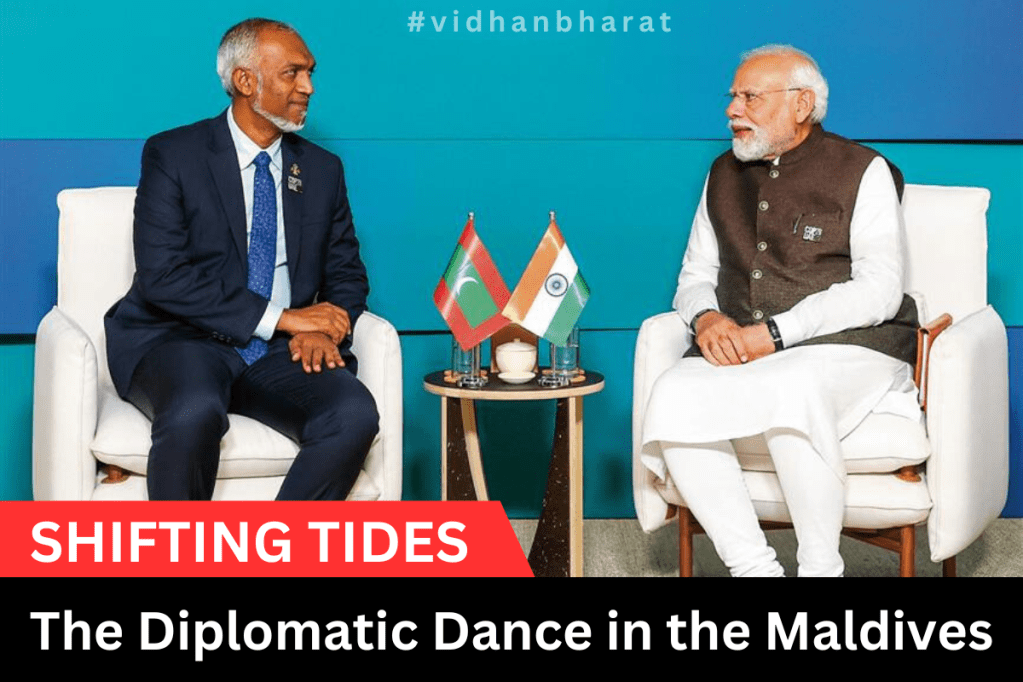
“Muizzu’s victory sparks a geopolitical shift as Maldives re-evaluates ties riding on the sustained tensions between India and China.”
In the heart of the Indian Ocean, a political tide sweeps through the Maldives, reshaping its foreign policy landscape. The recent election victory of President Mohamed Muizzu has set the stage for a diplomatic reshuffle of preference between India and China, with significant implications for regional influence. Maldives President Mohamed Muizzu has intensified the anti-India rhetoric by demanding the withdrawal of the 88 Indian troops stationed in the country by mid-March. Despite their small number, these troops have been in Maldives since 2010, engaged in bilateral cooperation that includes training Maldivian troops, combat support, reconnaissance, and humanitarian aid. Muizzu, perceived as pro-China, campaigned with the slogan “India Out,” aligning with the coalition government’s pro-China policy to reduce Indian influence.1
Tensions between India and the Maldives escalated after Maldivian ministers criticized Prime Minister Modi on social media, prompting calls for a boycott of tourism in Maldives by Indian netizens. President Muizzu’s shift towards Turkey and China, along with his persistence on the withdrawal of Indian military personnel, signals a change in his country’s priorities.
Muizzu’s ascendancy to power departed from his predecessor’s India-friendly stance, which had been a consistent line in Maldives’ foreign policy. With a campaign slogan echoing “India Out,” he rallied support for a reduced Indian influence, citing concerns over the military presence in the Maldives. Controversies surrounding gifts from Delhi, including helicopters and an aircraft, fuelled suspicions of India’s intentions. Muizzu, in his quest for a review of agreements, raised questions about the opacity of their contents, intensifying the diplomatic challenge for India.
China’s Strategic Moves
China granted $126 million for the Sinamale Bridge, connecting Male with the international airport. Though India offered significant financial assistance, it has not gone down well with the Maldivian policymakers. President Muizzu, while expressing commitment to Maldivian independence, elevated the relationship with China during his recent visit there, culminating in the signing of 20 agreements and a $130 million aid package for development projects.2 The specter of China’s strategic presence loomed large, with the Belt and Road project casting a shadow reminiscent of the Yameen era.
On the other hand, the outgoing president, Solih, focused on making ties stronger with India during his time, following a policy that puts India first because of its shared history, culture, and economy. India is considered a time-tested friend due to historical ties, shared democratic values, participation in strategic alliances, and a foreign policy emphasizing peaceful coexistence. In contrast, China is perceived as unreliable due to aggressive behavior in territorial disputes, alleged economic coercion, human rights concerns, and unpredictable foreign policy decisions. These factors contribute to a perception that India’s long-standing relationships and consistent values make it a reliable partner, while concerns about China’s actions and policies contribute to a perception of unreliability.
The change in leadership to Muizzu raises questions about how the relationship between India and the Maldives will develop in the future. The Maldives seems to be leveraging the rivalry between India and China to its advantage. The Maldivian President Mohamed Muizzu has taken a pro-China stance, especially evident in his anti-India rhetoric during his 2023 election campaign. His recent visit to China and the elevation of bilateral ties to a ‘comprehensive strategic cooperative partnership’ indicate a strengthening relationship with China. The Maldives is seeking to reduce its dependence on India, as reflected in President Muizzu’s call for the removal of Indian military personnel and a desire to balance trade relations away from what he perceives as a tilt in favor of India. The Maldives aims to emerge from India’s influence and align itself more closely with China in diplomatic and economic terms.
“China was our number one market pre-Covid, and it is my request that we intensify efforts for China to regain this position”.
– President Muizzu on the Maldives and China relation
Despite his alignment with China, Muizzu insists on not being explicitly pro-China. Balancing relations with India remains a daunting challenge, particularly concerning the withdrawal of troops. Muizzu’s victory, supported by former President Yameen, underscores the potential for a shift towards closer ties with China, echoing the past challenges faced during Yameen’s presidency.
Conclusion
The strategic importance of the Maldives in the Indian Ocean magnified the delicate balance of influence between major regional powers.3 China, ever eager to expand its footprint, has already invested significantly in the Maldives, fostering economic partnerships that stood in stark contrast to India’s historical influence. The coming months will unfold the trajectory of the Maldives’ relations with India and China, shaping the geopolitical landscape of this tropical archipelago.
- Why Maldives President Mohamed Muizzu Is Talking Tough: Explainer. NDTV.com. https://www.ndtv.com/india-news/why-maldives-president-mohamed-muizzu-is-talking-tough-explainer-4868525 ↩︎
- Maldives, China Sign 20 Agreements Amid Diplomatic Row with India. NDTV.com. https://www.ndtv.com/world-news/maldives-china-sign-20-agreements-after-mohamed-muizzu-xi-jinping-meeting-amid-diplomatic-row-with-india-4837748 ↩︎
- Anbarasan Ethirajan (2024, January 15). Maldives ultimatum on troops deepens row with India. BBC News. https://www.bbc.com/news/world-asia-india-67956846 ↩︎


 Vidhan Bharat
Leave a comment