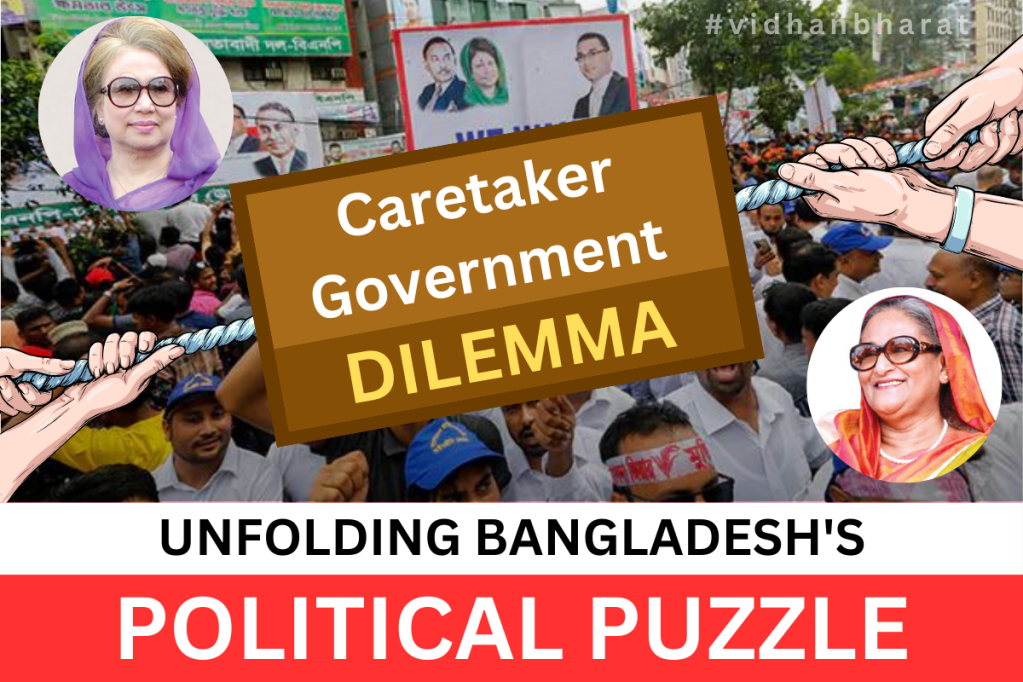
The most unique feature of the year 2024 is going to be the “Dance of Democracy” across the globe. Countries that are home to nearly half of the world’s population will pick their governments in elections in 2024. Bangladesh began 2024 with the first major election of the year and the incumbent Sheikh Hasina won a fourth consecutive term as Prime Minister. However, the largest opposition party, Bangladesh Nationalist Party (BNP) led by former PM Khaleda Zia, and its allies boycotted the election after Hasina refused to step down from her post to make way for a neutral caretaker Government. To understand the present scenario it is important to know about the caretaker government system in Bangladesh.
In Bangladesh, a caretaker government was first introduced in 1990 when three-party alliances jointly made a demand for it. It was constitutionalized in 1996 by the Parliament dominated by the Bangladesh Nationalist Party (BNP). The concept of caretaker Government is implemented in various ways in different countries. In Bangladesh, a caretaker government takes care of state administration for an interim period during the transition from one elected government to another. The head of the Caretaker Government is called the Chief Adviser and is selected by the President, and the Chief Adviser selects the other advisers. Since 1996, the Caretaker Government has held the elections of 1996, 2001, and 2008.
The caretaker government, 1996: In the face of continuous agitation of the combined opposition, on 21 March 1996 the 13th Amendment bill regarding caretaker government was raised in the Sangsad (parliament) of Bangladesh, and on 26 March 1996 it was passed by 268-0 vote. After formalizing the measures for a caretaker government and amid massive opposition agitation (Specifically Awami League), the controversial Sixth Jatiya Sangsad was dissolved on 30 March 1996. Afterward, a caretaker government was formed under the 13th Amendment, and the former Chief Justice, Muhammad Rahman, took over the charge as the Chief Adviser. The caretaker government successfully discharged its duty of holding the free and fair seventh parliamentary election on 12 June 1996 and continued in office till 23 June 1996, when the newly elected Awami League led by Sheikh Hasina formed the government.
The caretaker government of 2001: The second caretaker government was formed on 15 July 2001 and the former Chief Justice, Latifur Rahman, took over charge as the Chief Adviser. The caretaker government discharged its prime duty of holding the 8th parliamentary election on 1 October 2001 and continued in office till 10 October 2001 when the newly elected BNP government led by Khaleda Zia assumed state power.
Caretaker Government of 2006-08: An election was scheduled for the end of 2006; however it did not take place. The caretaker government was accused of BNP bias by Shaikh Hasina and her coalition, who instigated nationwide protests and shutdowns. In January 2007, the head of the caretaker government stepped down. Eventually, Fakhruddin Ahmed, former World Bank economist, was selected to replace him and has committed himself to rooting out corruption and preparing a better voter list. Here we have to note that the caretaker Government of Dr. Fakhruddin Ahmed was military-controlled. Furthermore, the national election of Bangladesh was held on 29 December 2008 under the Caretaker government formed with Dr. Fakhruddin Ahmed as the Chief Adviser on 13 January 2007. As a result, the Awami League came into the bigger picture after the chaos made by the BNP.
These historical developments show the political evolution of the caretaker government in Bangladesh. While Dr. Fakhruddin Ahmed’s caretaker government was enjoying the mandate of the Bangladesh Army, the constitutional validity of this government remains questionable. As per Bangladesh’s Constitution, “a Caretaker Government should be constituted within 15 days of the dissolution of the Jatiya Sangsad and should be in a position to hand over powers to a duly constituted popular government within 90 days after the dissolution of the previous parliament.” Hence, this government has already completed the stipulated time limit that qualifies itself to be a caretaker government. The caretaker government remained in the shadow of the Army’s dominance and raised concerns about the prospect of democracy in the country. People were in fear that the Army might just stay back under the saddle and delay the restoration of democracy.
In 2011, Awami League-led Bangladesh Government abolished the caretaker system because the system lost credibility in the Awami League’s eyes. According to them, the BNP has destroyed the country’s caretaker government system. “Under the BNP, elections were held in Bangladesh several times and every time was fraudulent and manipulated……..Now they are demanding a caretaker. And now they demand democracy. But when there was a military ruler in this country and every night there was a curfew, and the people had no right to speak, no right to vote, and suffered a lot, they didn’t want a caretaker government then.” Sheikh Hasina, on Caretaker Government Speaking to Time Magazine.
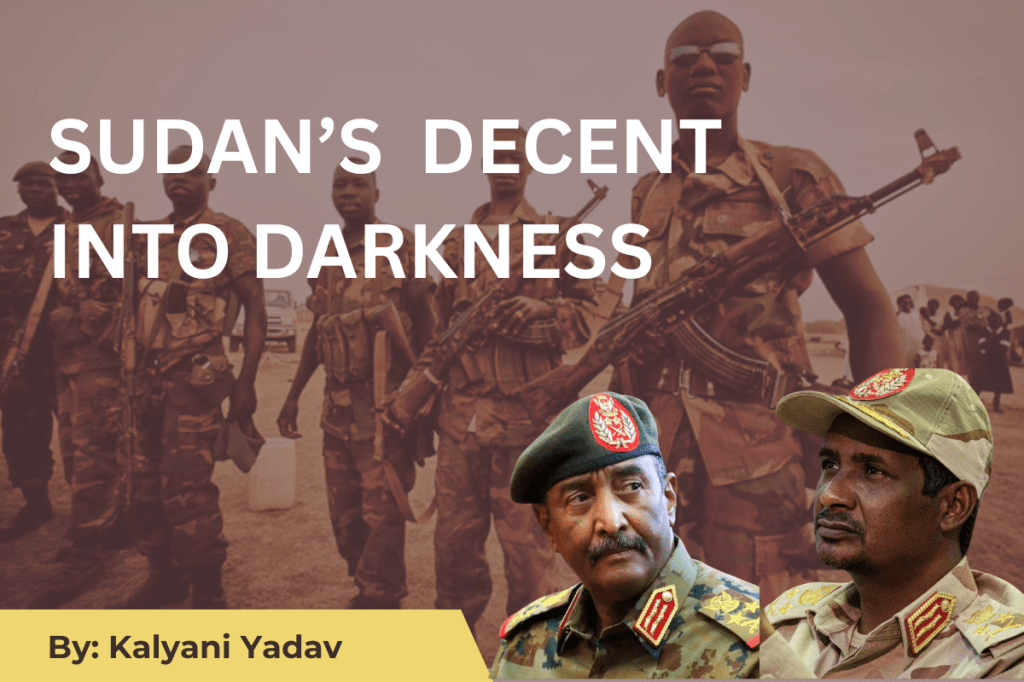
Neither do Caretaker governments in different parts of the world today inspire much confidence. The caretaker government which recently took power in Pakistan can potentially prolong its stay beyond 90 days if elections are not held on time. The caretaker government in Sudan resulted in a civil war.
Whether Bangladesh could adopt a Caretaker Government system or continue with present constitutional provisions is a matter of discussion. Meanwhile, Democracy should be sustained for the sake of Bangladesh. Concerning this scenario, Bharat Ratna Dr. B. R. Ambedkar’s thought matched perfectly.
“Political democracy can’t last long unless there lies at the base of it, social democracy. Social democracy means a way of life which recognizes liberty, equality, and fraternity as the principles of life.”
– Dr. B. R. Ambedkar


 Vidhan Bharat
Leave a comment