
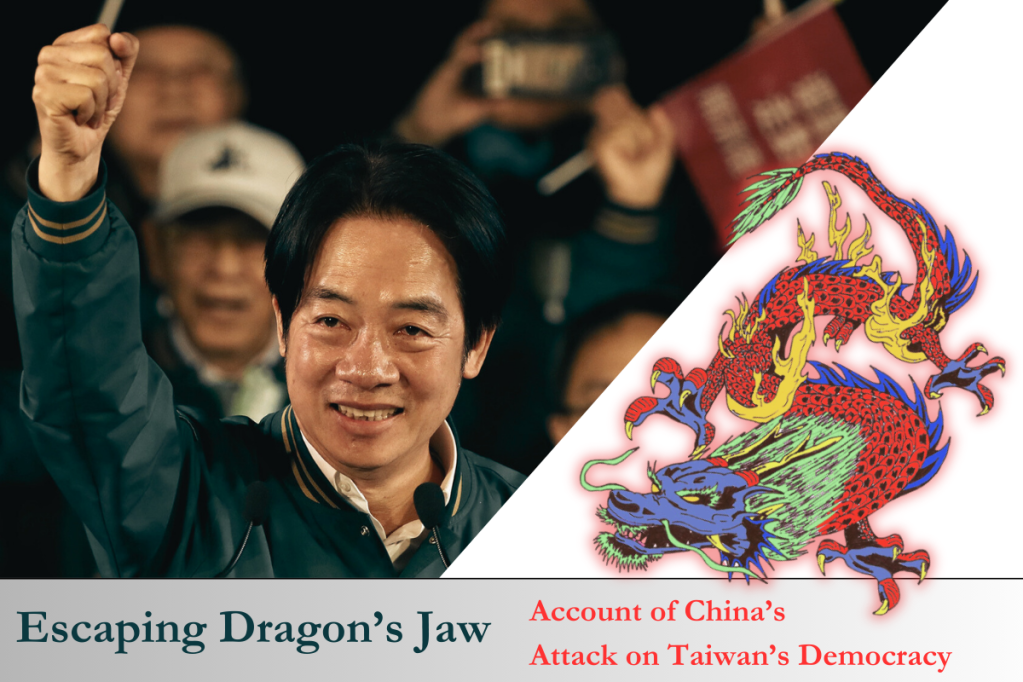
In recently concluded elections in Republic of China (Taiwan) pro Independence party leader Lai Ching-Te, who previously served as vice president in the government of ruling Democratic Progressive Party (DPP). This result is seen as snub to authoritarian Chinese Communist Party’s (CCP) narrative of One China Policy.
This result is significant not only from the geopolitics point of view but also from the fact a large portion of Chinese disinformation machinery was deployed to swing the results the other way.
Dragon’s Claws on Information Highway
Historically China has been involved in the long list of disinformation campaigns across the globe. Deepfakes and online hate campaigns target not only the governments but also the individuals who are critical of the CCP and its policies.
The US and its allies have constantly been in the crosshairs1 of the online barrage of hate speech manufactured and directed by Chinese IT cells. Fake social media accounts, its famous 50-cent army of keyboard warriors and ‘wolf warriors’ across various social media platforms2.
Project Taiwan
China refuses to acknowledge the sovereignty of Taiwan and claimed it as part of mainland China. However, this claim has always been met with severe protest from the 23 million Taiwanese population.
As a show of strength or as an attempt at subjugation; however, we may frame it; China weighed in with its disinformation machinery to tilt the electoral processes in Taiwan in its favour3. The onslaught was huge, relentless, and ruthless. From spreading misinformation regarding the citizenship of the running mate of now, president-elect Lai Ching-Te to nurturing fear of possible war with China. CCP did everything in its power to spread fear and influence the election outcome by dividing the voter class of Taiwan.
If I can influence 3 to 5 percent of the people, then I can influence the election result, and even if you don’t affect the election results, you have still furthered the unification campaign.
Chang Chun-Hao, a professor of political science at Tunghai University in Taiwan
A Four-Pronged Attack
- Sowing Information Chaos
News articles or social media posts were written and shared in masses that will put Taiwanese polarisation on steroids. Chinese propagandists were encouraged to amplify authentic local disputes and divisions in their messaging.
Consistent spread of rumors through its social media content-farming channels, Chinese propaganda machinery kept pushing information against government officials to stoke discontent. As per the details of ongoing trials, China’s state media has also been found to support a local Digital influencer company that has regularly criticised DPP an anti-China party. The messaging intended to create confusion among the voters.
- Co-opting Local Officials
During recent years CCP has frequently hosted heavily discounted visits for Grassroot public officials from Taiwan. Distributing amongst them flyers and running video ads that are blatantly pro-unification. Pushing the message that two lands across the Taiwan Strait are one nation and they must vote for pro-unification candidates.
- Wielding Economic Sticks and Carrots
From threatening to sever economic ties to incentivising pro-unification policies with trade benefits, the Chinese administration tried to woo voters towards parties with favorable agendas. The goal was to turn economic incentives into coercion tools to build pro-unification sentiment.
- Ramping Up ‘Gray Zone’ Military Intimidation
Lastly threat of military intervention. Actions that challenge Taiwan’s sovereignty stopping just short of outright conflict. Since December, China has sent at least 31 high-altitude balloons into Taiwan’s airspace. The sword rattling against the election of the pro-freedom party was another point of talk across Taiwan as many citizens were taken by concerns over conflict with China. These tactics can be seen as a form of intimidation of 23 million Taiwanese.
Bharat, The Weary Neighbor of China
Bharat is full of diversities when it comes to electoral narratives. In many cases, if left unchecked there is the possibility of political narratives getting highly polarised. With many potential fault lines across religions and castes; polarising campaigns can be very detrimental to the electoral proceedings and unity of the nation.
Another concern is the spread and permeation of information. As seen in the case of the Hamas- Israel conflict; fake news can spread like wildfire and usually damage is already done before the truth is revealed and substantiated. Democracy after all is heavily dependent on the sentiments of participant voters and thus a well-orchestrated fake news campaign can deal substantial damage to the election process.
Conclusion
This event shows that despite corrosive effects of disinformation; a strong political narrative can retain its advantage in democratic processes. Yet, literacy towards the propagation of information has become of prime importance when it comes to protecting democracy. Non-partisan fact-checking portals have become a necessary frontier against such campaigns. With modern communication challenges rising over the horizon; it has become of paramount importance to address these vital concerns.
- O’Sullivan, D., Devine, C., & Gordon, A. (2023, November 13). China is using the world’s largest known online disinformation operation to harass Americans, a CNN review finds. CNN. https://edition.cnn.com/2023/11/13/us/china-online-disinformation-invs/index.html
- Cook, S. (2022). Beijing’s Global Media Influence. Freedom House. https://freedomhouse.org/report/beijing-global-media-influence/2022/authoritarian-expansion-power-democratic-resilience 3 Wall Street Journal. (2024, January 11). Taiwan Fights Onslaught of Chinese Disinformation Ahead of Key Election [Video file]. https://www.wsj.com/video/taiwan-fights-onslaught-of-chinese-disinformation-ahead-of-key-election/F6F0C406-164B-4572-86B0-F54736B2B163

 Vidhan Bharat
Leave a comment