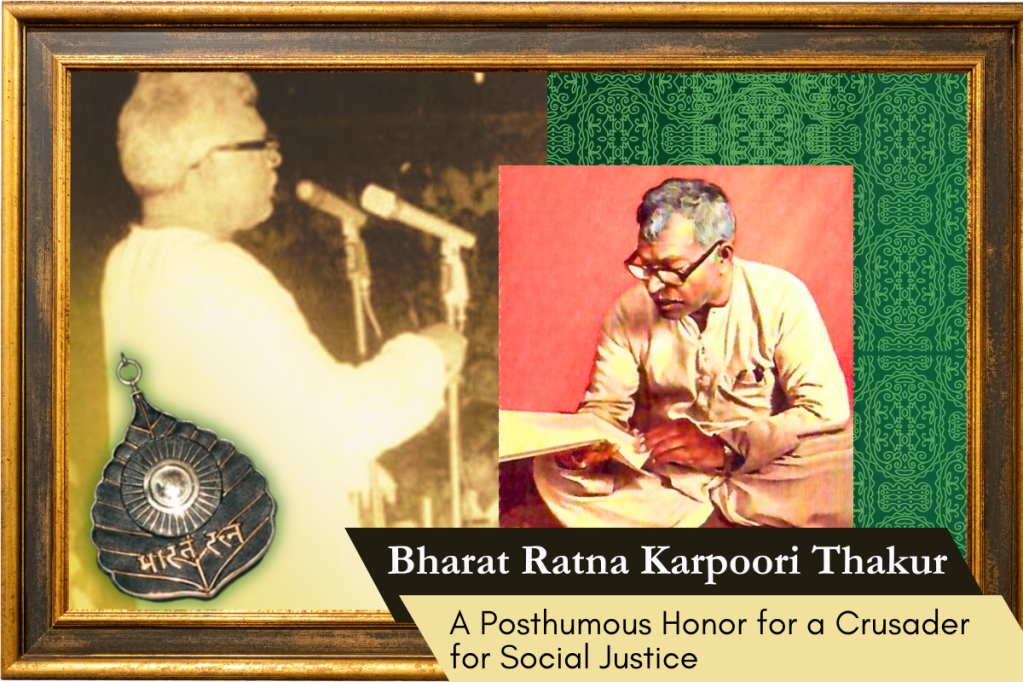
Karpoori Thakur was not only a pioneer of social justice but also a freedom fighter, a leader of farmers, a charismatic opposition figure, and an embodiment of simplicity. His political journey was shaped by his association with Mahatma Gandhi and Satyanarayan Sinha.
Karpoori Thakur embarked on a noteworthy political journey, actively engaging in the Indian independence movement and subsequently making significant contributions to Bihar’s political landscape. Born on January 24, 1924 and passing away on February 17, 1988, he served as the Chief Minister of Bihar for two terms. His first term spanned from December 1970 to June 1971, followed by another term from June 1977 to April 1979. Hailing from the Nai caste, a marginalized social group in Bihar politics, he played a pivotal role in the socialist bloc during the 1960s, navigating conflicts on ideological issues and the concept of reservations for backward classes.
Recognized as a trailblazer in social justice politics in India, Karpoori Thakur’s legacy extends beyond that designation. He was not only a pioneer of social justice but also a freedom fighter, a leader of farmers, a charismatic opposition figure, and an embodiment of simplicity. His political journey was shaped by his association with Mahatma Gandhi and Satyanarayan Sinha. He actively participated in the Quit India Movement, enduring a 26-month prison term for his dedicated role in the struggle for independence.
Following India’s independence, Karpoori Thakur transitioned into the role of a teacher and subsequently ventured into politics, securing a position as a Socialist Party candidate in the Bihar Vidhan Sabha in 1952. Throughout his political career, he consistently showcased a dedication to social justice and the well-being of marginalized communities. His activism led to his arrest in 1960 for spearheading a strike, and in 1970, he engaged in a 28-day fast in support of Telco laborers.
In response to the emergency in India from 1975 to 1977, Karpoori Thakur, alongside fellow socialist leaders, spearheaded the ‘Total Revolution’ movement, advocating for non-violent societal transformation. The Janata Party’s triumph over the ruling Indian National Congress in the 1977 Bihar Legislative Assembly election led to his reappointment as Chief Minister. However, internal discord arose over the implementation of reservations for Backward Castes, leading to his resignation in 1979.
Despite facing challenges, Karpoori Thakur steadfastly championed social justice and the rights of the poor. In 1978, he introduced a reservation model in Bihar, allotting percentages for various backward classes and economically disadvantaged groups. Renowned as the champion of the poor, he served as the President of the Samyukta Socialist Party and played a mentoring role for influential leaders like Lalu Prasad Yadav, Ram Vilas Paswan, Devendra Prasad Yadav, and Nitish Kumar.
Karpoori Thakur’s enduring legacy comprises his substantial contributions to Bihar’s political and social fabric, emphasizing the advocacy for marginalized communities’ rights and the promotion of education in the state. His alignment with Lohia’s brand of politics positioned him as a leading voice for the backward classes in Bihar, challenging the dominance of upper-caste politics in the region.
As the Minister of Education, he opted to eliminate English as a mandatory subject for matriculation, aligning with Lohia’s anti-English policy. This strategic decision democratized education in Bihar, providing marginalized segments of society access to higher education and employment opportunities. As a proponent of the Hindi language, he took this action during his tenure as the Education Minister in Bihar. However, the critics allege that Bihari students suffered from diminished standards of English-medium education in the state due to this policy. Karpoori Thakur’s public service included roles as a Minister and Deputy Chief Minister of Bihar, preceding his historic position as the first non-Congress socialist Chief Minister of Bihar in 1970. He also instituted a comprehensive prohibition of alcohol in Bihar and oversaw the establishment of numerous schools and colleges in less developed regions of the state.
During his term as Chief Minister, he implemented the Mungeri Lal Commission report, introducing a 26% reservation in state government jobs. This reservation system allocated 12% for the most backward castes, 8% for backward castes, 3% for upper castes, and 3% for women. The implementation of reservations effectively democratized Bihar’s society, increasing the representation of backward classes in politics, education, and employment. He also pioneered the introduction of Panchayati Raj elections in Bihar in 1978.
Whether it be Lalu Yadav, Nitish Kumar, or Sharad Yadav, each laid claim to being the true successor of Karpoori Thakur. His ideas, however, undeniably influenced a generation of socialist leaders in Bihar, catalyzing transformative socio-economic reforms.
In subsequent years, Lalu Yadav consolidated the OBC votes in Bihar, challenging the dominance of upper castes in the state assembly and other government institutions. Nitish Kumar furthered Thakur’s vision by implementing Extremely Backward Class (EBC) reservations in local body elections. Recently, the coalition government of Tejashwi and Nitish conducted a caste census and expanded the reservation quota, indicating the enduring impact of his idea of social revolution.
The much-anticipated demand of political parties in Bihar, including the RJD and the JD(U), was finally met with the Union government’s announcement of the posthumous Bharat Ratna honor for the dedicated socialist leader Karpoori Thakur. Widely recognized as Jan Nayak for his lifelong advocacy for the poor and marginalized, this honor acknowledges his enduring battle for the welfare of these communities.
References:-
- https://www.prabhatkhabar.com/state/bihar/patna/karpoori-thakur-bharat-ratna-from-bihar-news-know-bihar-cm-karpuri-thakur-kaun-the-skt
- https://navbharattimes.indiatimes.com/state/bihar/patna/former-bihar-chief-minister-karpoori-thakur-to-be-awarded-bharat-ratna-posthumously-an-unheard-story-about-karpuri-thakur/articleshow/107090420.cms
- https://www.thequint.com/opinion/bjp-governments-bharat-ratna-to-karpoori-thakur-bihar#read-more





 Vidhan Bharat
Leave a comment