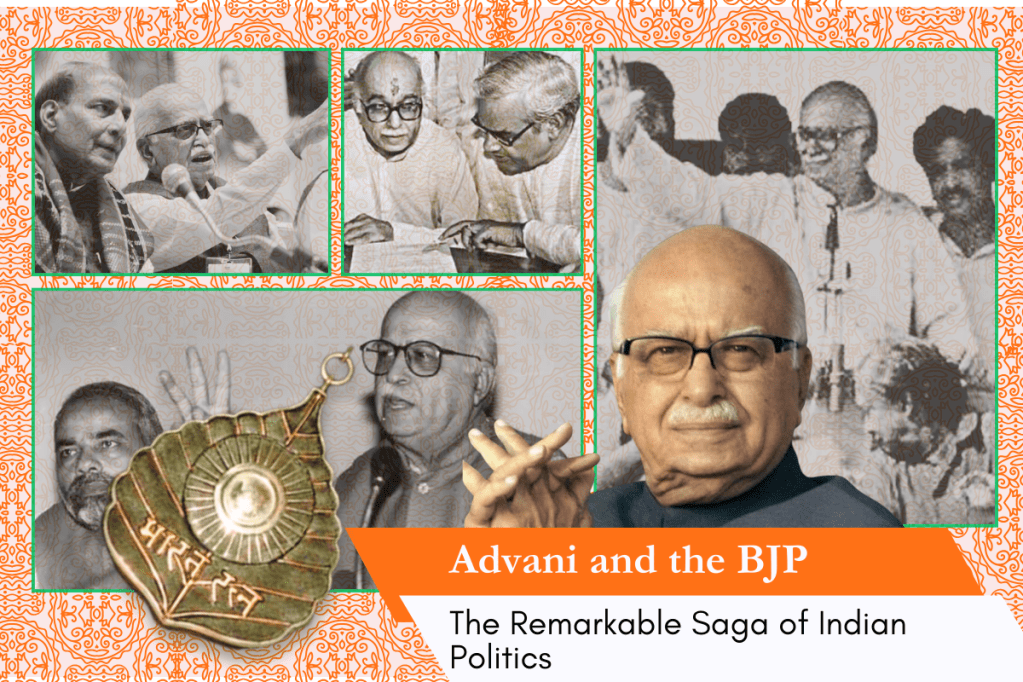
In Indian politics, few names stand as tall and enduring as that of Lal Krishna Advani. Born on November 8, 1927 in Karachi, now in Pakistan, Advani’s life has been intertwined with the intricate threads of India’s socio-political landscape, marked by tumultuous events like the partition and the rise of right-wing politics.
Advani’s journey in politics began at the tender age of fourteen when he joined the Rashtriya Swayamsevak Sangh (RSS), a right-wing Hindu nationalist organization. His early years were spent as a pracharak, a full-time worker, where he diligently conducted shakhas (gatherings) and assumed responsibilities within the organization. Post-partition, he continued his work in Rajasthan, immersing himself in the socio-political milieu of the region.
The political bug bit Advani in 1951 when he became a member of the Bharatiya Jana Sangh (BJS), a political party founded by Syama Prasad Mookerjee. Advani’s ascent within the party was swift; he served in various capacities, from being a general secretary to eventually becoming the president of the Delhi unit. His tenure as the chairman of the Delhi Metropolitan Council from 1967 to 1970 further solidified his political acumen.
The turning point in Advani’s political career came with the formation of the Bharatiya Janata Party (BJP) in 1980, where he played a pivotal role alongside stalwarts like Atal Bihari Vajpayee. The BJP’s ideological shift towards Hindutva, under Advani’s leadership, heralded a new era in Indian politics, marked by fervent nationalism and the assertion of Hindu identity.
One of the defining moments in Advani’s career was his involvement in the Ram Janmabhoomi movement. As the face of the BJP, he spearheaded the movement, advocating for the construction of a temple at the disputed site in Ayodhya, believed to be the birthplace of Lord Ram. The demolition of the Babri Masjid in 1992 followed by allegations against him for delivering provocative speeches, thrust him into the center of a political storm. However, he was eventually acquitted in 2020.
Advani’s journey reached its zenith when the BJP-led National Democratic Alliance (NDA) came to power in 1998, with Atal Bihari Vajpayee as the Prime Minister and Advani as the Deputy Prime Minister and Minister of Home Affairs. His tenure was marked by both accolades and challenges, including the fallout of the Kargil War and the failed attempt to broker peace with Pakistan through the Lahore Declaration.
Despite the highs and lows, Advani remained a steadfast figure in Indian politics, steering the BJP through turbulent waters. His bid for prime ministership in the 2009 general elections marked the culmination of decades of dedicated service to the nation. Although unsuccessful, his legacy as a stalwart of Indian politics remained intact. In the twilight of his political career, Advani continued to wield influence within the BJP, albeit from behind the scenes. His role as a guiding force within the Marg Darshak Mandal, alongside luminaries like Atal Bihari Vajpayee and Murli Manohar Joshi, underscored his enduring relevance within the party.
The accolades bestowed upon Advani, including the Padma Vibhushan in 2015 and the Bharat Ratna in 2024, served as a fitting tribute to his contributions to the nation. Beyond the realms of politics, his life is a testament to resilience, determination, and unwavering commitment to his ideals.
As India marches forward into the 21st century, the legacy of Lal Krishna Advani serves as a guiding light, reminding us of the power of conviction, leadership, and above all, the unwavering spirit of nationalism. In the annals of Indian history, his name will forever be etched as a colossus, a true titan of Indian politics.





 Vidhan Bharat
Leave a comment