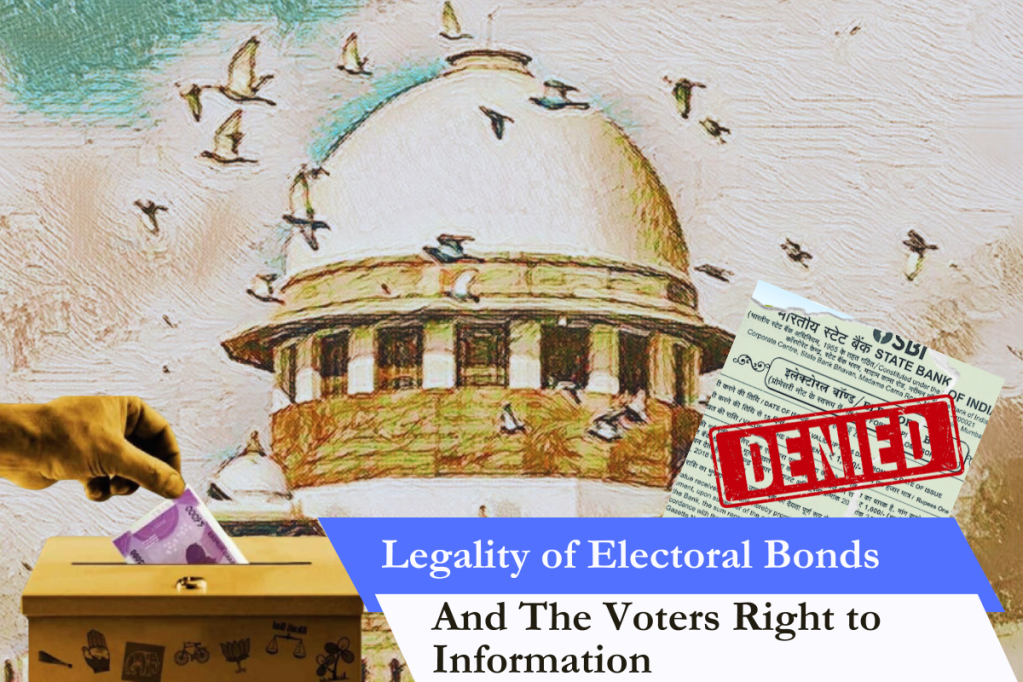
A five-judge bench of the Supreme Court gave its landmark verdict on the legality of the electoral bonds holding it “unconstitutional”. Emphasizing transparency in political funding, the court reaffirmed its commitment to safeguarding India’s electoral integrity.
The Electoral Bonds emerged as a contentious subject, raising profound questions about transparency, accountability, and the very essence of fair political competition in India. As these bonds have become the primary mode of political funding, constituting a significant portion of financial support for political parties, their legality has been brought under the judicial microscope, igniting debates and legal battles that have culminated in a landmark Supreme Court ruling.
At the heart of the debate surrounding electoral bonds lies the issue of transparency. Unlike traditional forms of political donations, which necessitate disclosure of a donor’s identity, electoral bonds afford anonymity to contributors. This opacity, critics argue, undermines the fundamental principles of democratic governance by obfuscating the origins of political funding, potentially paving the way for corruption and undue influence.
Electoral bonds are like special money notes that people can buy in different amounts and give to political parties they support. These bonds can be bought by anyone – individuals, groups, or companies. The parties that get these bonds can cash them in after 15 days, without paying any extra money. Unlike regular donations, where big donors’ names must be shared if they give more than 20,000 rupees in cash, the names of electoral bond donors are always kept secret, no matter how much they give. Electoral bonds have become the main way for political parties to get money. A report found that 56% of all the money donated to political parties comes from electoral bonds.
Some people were in favor of electoral bonds because the donor can donate without anyone knowing. But this secrecy also worries many people. They think it’s not fair and could hide corrupt activities.
Petitions were filed by the Communist Party of India (Marxist), and NGOs Common Cause and ADR. In 2017 and 2018, they asked the Supreme Court to stop the use of electoral bonds. Now, after six years, the court has decided on the case.
Clause 12 of the Electoral Bond states that “the bond can be encashed only by the political party by depositing it in the designated bank account”.
The government defended anonymity for corporate donors aiming to reduce black money’s influence in elections, despite “public interest” not being listed in Article 19(2). The Constitution Bench clarified that only Article 19(1)(g) could be restricted for the public interest. While the government argued anonymity encourages donations via banking channels, the bench noted that withholding political expenditure information lacks a rational connection to curbing black money or unregulated funds.
The purchase of electoral bonds and subsequent conversion into cash for donation to political parties constituted a circumvention of transparency measures. The scheme violates the right to information under Article 19(1)(a), which guarantees the “freedom of speech and expression”. Furthermore, the court argued that restrictions on the rights under Article 19(1)(a) are permissible only on grounds delineated in Article 19(2), which do not encompass the objective of curbing black money even if such an objective were tangentially connected to grounds in Article 19(2).
The lack of disclosure of donor identity associated with electoral bonds has faced legal challenges, with critics arguing that it contravenes the Right to Information (RTI) Act. This legislation empowers citizens to access information from public authorities, and the secrecy surrounding electoral bonds goes against the transparency and accountability principles upheld by the act.
The court proffered Section 29C of the Representation of People Act 1951, as a less restrictive alternative mechanism. The court observed that this provision, in its pre-amended form, mandated political parties to disclose contributions exceeding Rs. 20,000. The amendment introduced by the Finance Act 2017, which exempted political parties from disclosing donations received through electoral bonds, was invalidated by the court.
Electoral bonds have faced criticism for evading scrutiny by the Election Commission of India (ECI). Unlike traditional modes of political funding like cheques or online transfers, electoral bonds are not subject to disclosure to the ECI. This absence of oversight has raised apprehensions about possible misuse and undermines the ECI’s capacity to oversee political financing adequately.
The Supreme Court also opined that the scheme breaches Article 19(1)(a) by impeding freedom of speech. The court deems this infringement disproportionate for combating black money. The court also said that the financial contributions are usually made for two reasons. One is support for a political party. Second, as a quid pro quo. Large corporate donations shouldn’t mask motives of other contributors. Also they said that the contributions made by the corporate sectors are solely business dealings aimed at gaining reciprocal advantages.
The legal saga surrounding electoral bonds has illuminated the intricate interplay between constitutional principles and contemporary challenges in political financing. As India navigates the complex terrain of democratic governance, the resolution of this constitutional quandary marks a pivotal step toward fostering greater transparency, accountability, and equity in its electoral landscape. With the specter of corruption looming, pursuing a more transparent and inclusive democracy remains imperative for India’s continued progress and prosperity.
References:
- Venkatesan, V. (2024, February 20). Supreme Court declaring electoral bonds
unconstitutional is a monumental defense of democracy. Retrieved from:
https://frontline.thehindu.com/columns/supreme-courts-decision-to-declare-electoral-bonds-unconstitutional-is-a-monumental-defense-of-democracy/article67852053.ece - Karpuram, A. S. (2024, February 15). SC strikes down electoral bonds scheme as unconstitutional: What grounds did the verdict rely upon? The Indian Express. Retrieved from: https://indianexpress.com/article/explained/explained-law/supreme-court-strikes-down-electoral-bonds-scheme-as-unconstitutional-what-issues-did-the-verdict-mention-9162710/
- Bhaumik, A. (2024, February 16). Electoral Bonds SC Verdict: Why did the Supreme Court strike down the electoral bonds scheme? | Explained. The Hindu. Retrieved from:
https://www.thehindu.com/news/national/why-did-the-supreme-court-strike-down-the-electoral-bonds-schemeexplained/article67848657.ece - NDTV. (2024, February 15). Electoral Bonds Supreme Court | Electoral Bonds Scheme Unconstitutional Should Be Canceled: SC. YouTube. Retrieved from:
https://www.youtube.com/watch?v=s9zCS2AWFqM - Bhalla, V. (2024, February 16). Explained: Why the Supreme Court struck down the electoral bonds scheme. Scroll. in. Retrieved from:
https://scroll.in/article/1063790/explained-why-the-supreme-court-struck-down-the-electoral-bonds-scheme




 Vidhan Bharat
Leave a comment