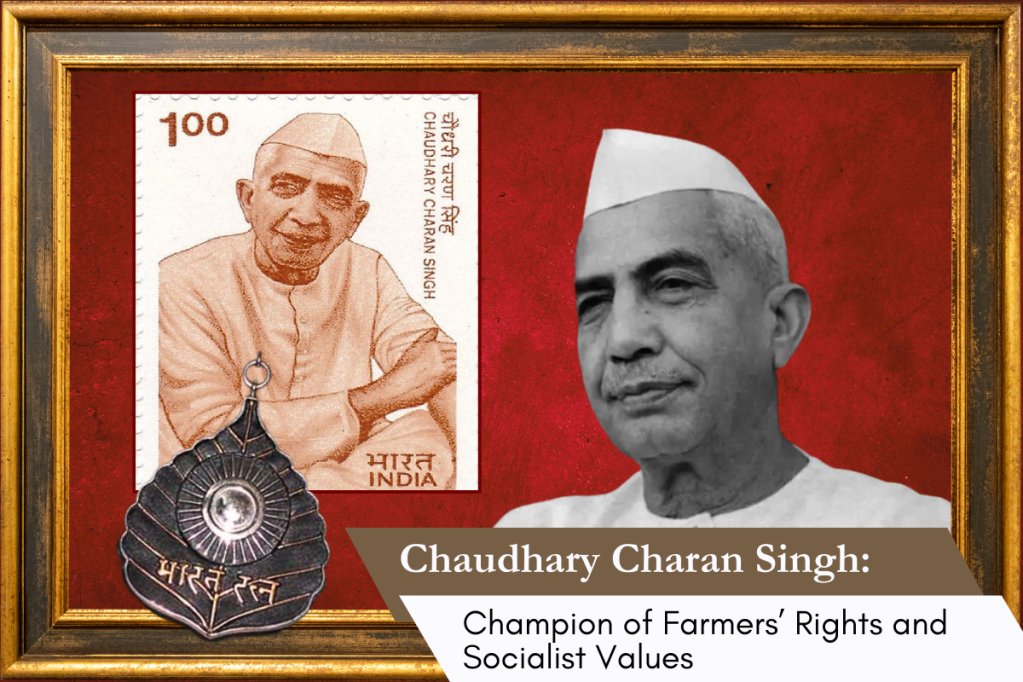
In recognition of Chaudhary Charan Singh’s unwavering dedication to democracy and the empowerment of farmers, the Government of India posthumously confers upon the former Prime Minister the prestigious Bharat Ratna award. Charan Singh, an eminent figure in Indian politics, spearheaded land reforms in Uttar Pradesh, leaving an indelible mark on the nation’s socio-economic landscape.
Prime Minister Modi lauds Singh’s pivotal roles as the Chief Minister of Uttar Pradesh, Union Home Minister, and his steadfast leadership during the Emergency period, highlighting his exceptional commitment to nation-building. The Prime Minister further remarks, “his devotion to democracy and his dedication to the farmers are an inspiration for all of us.”
Chaudhary Charan Singh: A Profile
Born into a middle-class agricultural family on December 23, 1902, in Meerut, Uttar Pradesh, Chaudhary Charan Singh embarked on his political journey as a member of the Congress party, later ascending to represent Uttar Pradesh in the state assembly on multiple occasions. He ascended to prominence in Indian politics, serving in various governmental capacities, including Cabinet Minister for Law and Information and Parliamentary Secretary.
During his illustrious political career, Singh briefly held the position of the fifth Prime Minister of India from 1979 to 1980 amidst political turmoil. Additionally, he served as the Chief Minister of Uttar Pradesh twice, from 1967 to 1968 and in 1970. A scholar of economics, Singh played a pivotal role in establishing institutions such as NABARD and spearheaded rural electrification initiatives. He passed away on May 29, 1987, at the age of 84, with his birth anniversary on December 23 celebrated as ‘Kisan Diwas’ (Farmers’ Day).
A prominent member of the Janata Party, Charan Singh was not only a seasoned politician but also a prolific writer. His commitment to societal welfare and economic reforms is reflected in his literary works, encompassing essays on agricultural policies and land reforms.
Contribution to Land Reforms
The Green Revolution improved the economic lot of the middle-class peasantry in northern India, and his land reform policies gave them newfound social and political clout. He staunchly supported farmers’ rights to land ownership.
In a seminal paper titled “Why 60% of Services Should Be Reserved for Sons of Cultivators,” published on March 21, 1947, Charan Singh succinctly articulated his vision for ensuring representation of ‘sons or dependents of the actual tillers of the soil’ in governmental positions and publicly funded schools.
Renowned as the driving force behind land reforms in Uttar Pradesh, Charan Singh spearheaded several landmark legislative measures aimed at addressing issues of land distribution and agricultural sustainability. Notable among these are the Department Redemption Bill of 1939 and the Land Holding Act of 1960.
Charan Singh’s legislative endeavors also included the enactment of laws supporting farmers, such as the Uttar Pradesh Zamindari and Land Act and the Consolidation of Holdings Act of 1953. He represented the Chhata assembly constituency in Mathura district five times in the UP Legislative Assembly.
In conclusion, the conferment of the Bharat Ratna upon Chaudhary Charan Singh serves as a poignant tribute to his enduring legacy and invaluable contributions to the nation’s progress and welfare.
References:
- ET Online (2024). Who is Chaudhary Charan Singh: Bharat Ratna winner, symbol of farmer empowerment. The Economic Times. Retrieved from: https://economictimes.indiatimes.com/news/india/who-is-chaudhary-charan-singh-bharat-ratna-winner-symbol-of-farmer-empowerment/articleshow/107596481.cms?from=mdr
- PTI (2024). Bharat Ratna to Chaudhary Charan Singh is an honor to India’s 90 crore farmers: UP Minister, Hindustan Times. Retrieved from: https://www.hindustantimes.com/india-news/bharat-ratna-to-chaudhary-charan-singh-is-honour-to-india-s-90-crore-farmers-up-minister-101707626381069.html





 Vidhan Bharat
Leave a comment