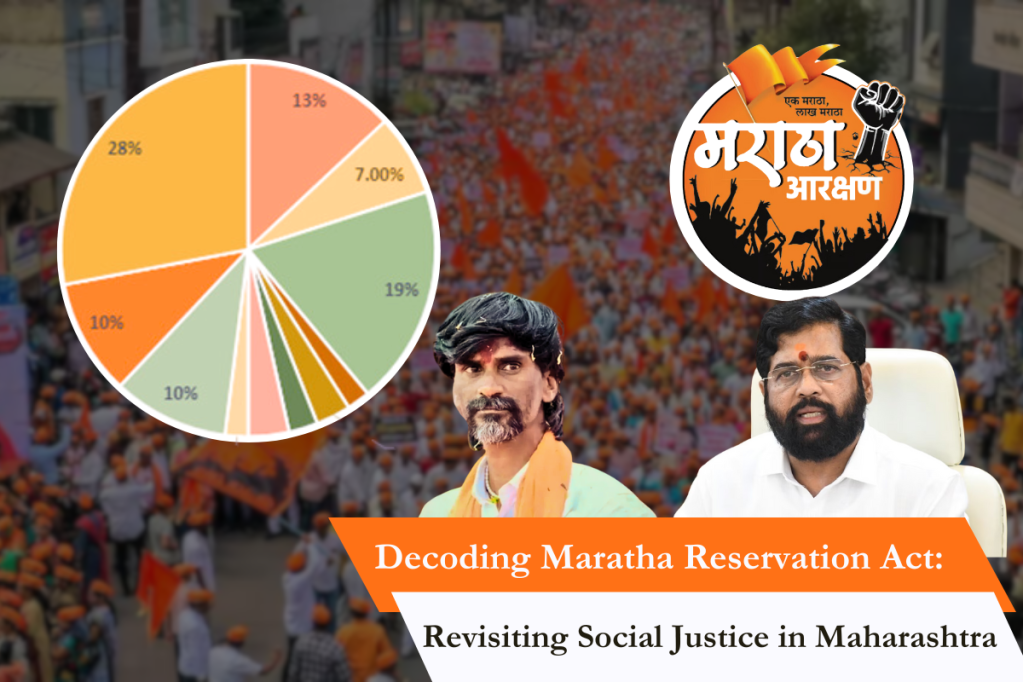
In a landmark move towards ensuring social justice and equitable representation, the Maharashtra Legislature passed a Maratha Reservation Bill on 20th February 2024. Subsequently, it converted into an act on 26th February 2024. It aimed at providing a 10% quota in the education and employment sectors to deserving candidates from the Maratha community in the state. The act, which has been a subject of intense debate and discussion, marks a significant milestone in the state’s commitment to provide equal opportunities to all segments of society.
The Maharashtra State Reservation for Socially and Economically Backward Classes (SEBC) Act 2024, presented by Chief Minister Eknath Shinde, was drafted based on a Maharashtra State Backward Class Commission Report. The report identified the Maratha community as socially and educationally backward. Therefore, the act aims to provide reservations for people from SEBC. The act mirrors the SEBC Act, 2018, previously introduced during the tenure of the then Chief Minister Devendra Fadnavis.1
A section of Marathas in Vidarbha, Konkan, and North Maharashtra have availed of OBC reservation based on the caste certificates issued since 1992. However, at that time, Marathas in Marathwada and Western Maharashtra were not inclined towards getting registered as OBC, perhaps due to the social stigma attached to the lower castes in India. Over time, with the worsening socio-economic conditions, they also started demanding the reservation by seeing it as a means to be developed.
In 2016-17, members of the Maratha community, under the Sakal Maratha Samaj, organized a two-phase state-wide agitation, demanding separate reservations in education and employment.
In 2018, the then Chief Minister, Devendra Fadnavis, declared reservation for the Maratha community under the SEBC Act. While the Bombay High Court upheld the act, the Supreme Court overturned it in 2021, casting doubt on Marathas’ backwardness.2
While speaking in the State Assembly, Chief Minister Eknath Shinde said, “The state government has decided to give 10% reservation to Marathas based on the State Backward Class Commission report that has established their social and educational backwardness.” He further added that the draft notification was in accordance with the existing rules.3
According to the report of the Maharashtra State Backward Class Commission, “Economic backwardness is the highest barrier to education. Inadequate education frequently leads to poverty and vice-versa. The Maratha community has faced challenges in economic prosperity, including diminishing agricultural returns, fragmentation of land holdings, erosion of traditional dignity linked to agriculture, and insufficient focus on the educational development of youth.”
The Commission found that the Maratha community is a SEBC according to Article 342A and Article 366(26C) of the Constitution.4
Article 15(4) of the Indian Constitution allows the State to make special provisions for advancing socially and educationally backward classes of citizens, including reservations in educational institutions.
Article 15(5) of the Indian Constitution allows the government to make special provisions to help socially and educationally disadvantaged groups get admission to educational institutions, even private ones. This applies to both aided and unaided institutions, except minority educational institutions mentioned in Article 30(1).
Article 16(4) of the Indian Constitution enables the State to provide reservations in public employment for backward classes of citizens, not adequately represented in the services under the State.
Reservation in Maharashtra
The following pie chart gives an idea regarding the breakdown of the existing 62% reservation in Maharashtra.5
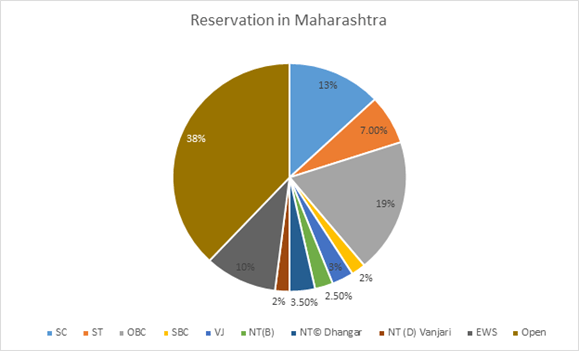
After the Maharashtra State Reservation for Socially and Economically Backward Classes (SEBC) Act 2024, the total reservation will be 72% in the state. The following pie chart provides a visual representation of the distribution breakdown.

On the surface, it seems to be the case that the Marathas with Kunbi certificates may continue to avail reservation under the OBC quota, as has been the case in the State. Along with it, now the other Marathas can avail of the newly introduced 10% SEBC quota.
“Marathas can now benefit from reservation both under the Maratha quota and OBC status. Those possessing Kunbi certificates will be eligible for OBC reservation, while those without will fall under the 10% quota,” expressed by Haribhau Rathore, OBC leader.
It is not clear whether the eligible candidates for the 10% SEBC quota can also apply for the 10% EBC quota as introduced in 2019 by the Union Government through the constitutional amendment.
Section 12 of the SEBC 2024, Act mandates the application of the Maharashtra Scheduled Castes, Scheduled Tribes, Vimukta Jati, Nomadic Tribes, Other Backward Classes, and Special Backward Classes Act of 2000, along with its associated rules, with appropriate adjustments, for issuing caste certificates to the Maratha community as socially and educationally backward.
One of the most contentious aspects of the act is the provision for reservation in private educational institutes. While this move has garnered both support and criticism, proponents argue that it is essential to ensure equal access to opportunities across all sectors of the economy. However, the implementation of this provision is likely to pose practical challenges and requires careful consideration.
The Reservation Act holds significant implications for the socio-economic landscape of Maharashtra. By expanding reservation benefits and promoting inclusive policies, the state government seeks to create a more equitable society where every individual has access to opportunities based on merit and not just social background.
The Government of Maharashtra has carefully reviewed the report, findings, conclusions, and recommendations of the Commission. Based on a comprehensive study of the various aspects of the report relating to the Maratha community the Government believes that-
- The Maratha community is a socially and educationally backward class and should be specified as such class under Article 342A (3) of the Constitution of India and reservation should be made for that class under Article 15(4), 15(5), and Article 16(4) of the Constitution.
- The existence of exceptional circumstances specified by the Commission authorizing reservation to the Maratha community to the extent of more than 50% in reservation in admissions to educational institutions and reservation in public services and posts.
- To the Maratha community, 10% reservation in public services and 10% reservation in admissions to educational institutions is necessary.
- It is desirable to make special provision by law for reservation in public services for the upliftment of socially and educationally backward classes and admissions to educational institutions other than minority educational institutions specified in clause (1) of Article 30 of the Constitution of India.
However, the implementation of the act is likely to encounter various challenges, including administrative hurdles, resistance from certain sections of society, and concerns regarding the efficacy of reservation policies in addressing deep-rooted inequalities. Moreover, ensuring transparency and accountability in the allocation of reserved seats remains a critical aspect of successful implementation.
The Act underscores the socio-economic struggles of the Maratha community, noting a significant portion living below the poverty line and experiencing high rates of farmers’ suicides. Marathas, constituting about 28% of the state’s population, qualify for reservation based on social and educational backwardness. The act grants the state government authority to compile a list of socially and educationally backward communities, with a review of the reservation policy slated every decade.6
The passage of the Reservation Bill by the Maharashtra Legislature represents a crucial step towards realizing the principles of social justice and inclusivity enshrined in the Constitution. By reaffirming its commitment to affirmative action and equitable representation, the state government sends a strong message of solidarity with marginalized communities and sets an example for other regions to follow. However, the true impact of the bill will ultimately depend on its effective implementation and the collective efforts of all stakeholders in promoting a more just and inclusive society.
References:
- Maharashtra cabinet passes bill granting 10% reservation to Maratha community. (2024, February 20). Retrieved from: https://www.fortuneindia.com/macro/maharashtra-cabinet-passes-bill-granting-10-reservation-to-maratha-community/115871
- L. (2024, February 20). Maratha quota: CM Eknath Shinde tables Maratha Reservation Bill in Maharashtra assembly today | Mint. Retrieved from: https://www.livemint.com/news/india/maratha-quota-maharashtra-cabinet-approves-draft-bill-for-10-reservation-in-govt-jobs-education-11708406189963.html
- Deshpande. (2024, February 21). Maharashtra clears 10% Maratha quota, Shinde says it will survive the test of law. The Indian Express.
- Bhalekar, R. A. (2024, February 20). Maratha reservation bill for 10% quota cleared by Maharashtra Assembly. India Today. Retrieved from: https://www.indiatoday.in/india/story/maharashtra-assembly-clears-maratha-reservation-bill-community-to-get-10-quota-in-education-jobs-2504615-2024-02-20
- E. (2023, January 23). All Maharashtra Caste List 2024 Reservation Wise Cast List. EducationHint Online Education Portal. Retrieved from: https://www.educationhint.com/all-caste-list-in-maharashtra/
- Maratha Quota Bill: An explainer on the three key features. (2024, February 21). Moneycontrol. Retrieved from: https://www.moneycontrol.com/news/india/maharashtra-three-key-features-of-maratha-quota-bill-explained-12320251.html



 Vidhan Bharat
Leave a comment