
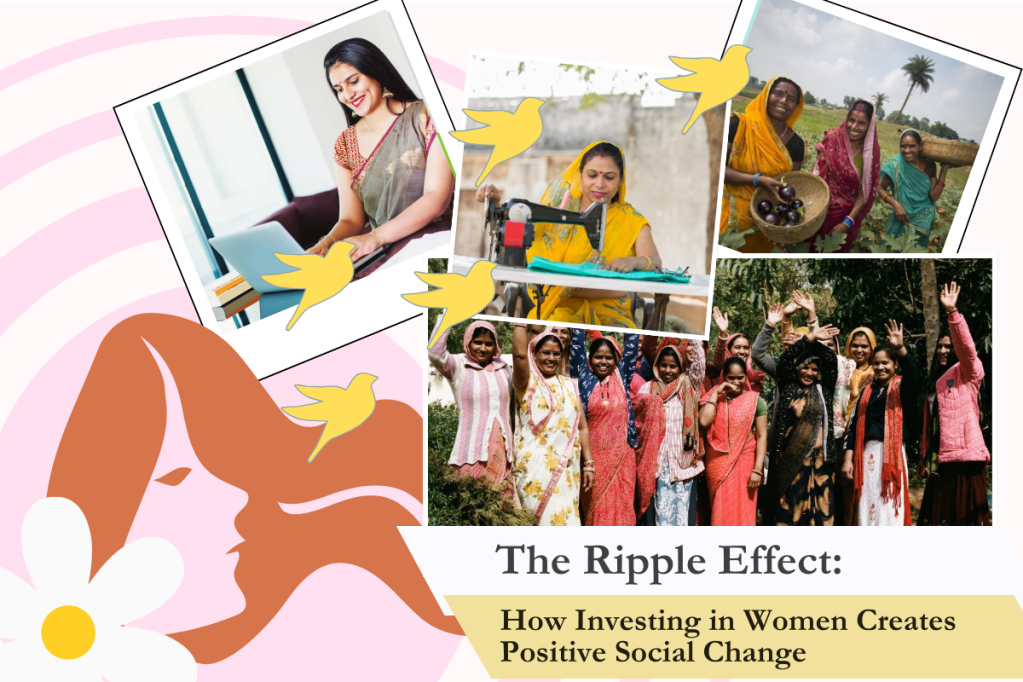
India, a country rich in cultural diversity and economic potential, has been witnessing significant strides in its development. However, despite progress, gender inequality remains a persistent challenge. Investing in women is not only a matter of social justice but also a strategic move that can catalyze positive social change across various domains in India.
Empowerment is a multi-faceted and multidimensional notion. Women’s empowerment is a process in which women achieve greater control over resources, whether material, intellectual, or financial. However, women in general, and particularly in India, lack ownership of productive assets, limiting their independence.
Self-help groups facilitated by microcredit have been demonstrated to have a good influence on women, with some of these effects resulting in ripple effects. The ripple effect of empowering women through investments and its far-reaching impacts on the economy, education, health, and community development is worth paying attention to.
Economic Empowerment
Investing in women’s economic empowerment has a direct and immediate impact on the overall economy. When women, who make up around half of the population, are given equal opportunities in the workforce, they contribute significantly to productivity and GDP growth. By providing women with access to education, training, and employment opportunities, they become key contributors to the labor market, fostering innovation and entrepreneurship.
Moreover, studies consistently show that women tend to invest a significant portion of their income in their families and communities. This multiplier effect helps break the cycle of poverty by improving the standard of living for not only the women themselves but also their children and communities. Increased financial independence for women is a powerful catalyst for economic growth and poverty reduction.
Rising rates of female labor force participation can stimulate economic growth, but research indicates that merely providing jobs for women is insufficient. Equal compensation for equal effort, strong social safety, and access to respectable employment are all necessary components of women’s economic participation.
Just 61% of women in their prime working age are employed, compared to 90.6% of men. In addition, around 60% of women globally work in the unorganized sector; in low-income nations, this percentage soars to over 90%.1 A significant fraction of them works as seasonal farm laborers, domestic helpers, construction workers, or in low-paying, unskilled occupations without social security benefits.2
Hence, putting money into well-trained, respectable occupations for women benefits society more broadly and not only advances gender equality but also fosters sustainable economic growth for everybody.
Education and Skill Development
Women’s education refers to any type of education that aims to improve the knowledge and abilities of women and girls. It covers general education in schools and colleges, vocational and technical education, professional education, and health education, among other things, and incorporates all facilities and opportunities for female learners.
In the field of international development, research on the socio-economic effects of women’s education is rapidly expanding. Increases in the number of women educated in a region are linked to high levels of development.
Some of the consequences are linked to economic growth. Women’s education raises their earnings and contributes to GDP growth. Other side effects are linked to societal progress. Women’s education has a lot of societal benefits, many of which are tied to women’s empowerment.
The Indian government has stated a strong commitment to universal education; however, India continues to have one of Asia’s lowest female literacy rates. In 2020, the female literacy rate was 70.3%, implying that 29.7% of women in India remain illiterate.3 This low literacy rate has a severe influence not only on women’s lives but also on their families’ lives and the economic development of the country. Illiterate women, according to various studies, have a high risk of fertility and mortality, poor nutritional status, little economic potential, and little household autonomy.4 Thus, the health and well-being of a woman’s children are also negatively affected by her lack of education.
Social and Cultural Impact
The ripple effect of investing in women extends to the fabric of social and cultural norms. As women gain empowerment, they challenge and reshape outdated stereotypes and discriminatory practices. When women have a seat at the table, diverse perspectives enrich decision-making processes, fostering more inclusive and equitable societies. This cultural shift not only benefits women but also dismantles harmful stereotypes that hinder the progress of entire societies. Investing in women becomes a catalyst for cultural transformation, promoting values of equality, respect, and diversity.
As the gender budget’s share of the overall union budget rose from 5% in 2023–2024 to 6.5% in 2024–2025,5 more such kinds of steps are needed. Because, investing in women in India has the potential to create a transformative ripple effect across various sectors, ultimately leading to positive social change. Economic empowerment, education, health, and community development are interconnected aspects that, when addressed holistically, can break down barriers and create a more equitable and prosperous society.
Conclusion
As India continues its journey towards development, recognizing the critical role of women and actively investing in their empowerment is not just a moral imperative but a strategic necessity. The ripple effect generated by supporting women will contribute to a more vibrant and inclusive India, unlocking the full potential of its diverse population for the benefit of current and future generations.
References:
- 2024, 28 February (2024) How can gender equality reduce poverty? UN Women – Headquarters. Retrieved from https://www.unwomen.org/en/news-stories/explainer/2024/02/how-can-gender-equality-reduce-poverty
- Ibid.
- Asadullah & Yeasmin, M. (February 2022). Socio-economic impact of Women Education in India (no date) ijrpr. Retrieved from https://ijrpr.com/uploads/V3ISSUE2/ijrpr2716-socioeconomic-impact-of-women-education-in-india.pdf
- Ibid.
- Ministry of Women and Child Development. (February 2024). Gender Budget increases by 38.6% in FY 2024-25. PIB. Retrieved from https://pib.gov.in/PressReleasePage.aspx?PRID=2001975#:~:text=The%20quantum%20of%20Gender%20Budget,5%25%20in%202023%2D24





 Vidhan Bharat
Leave a comment