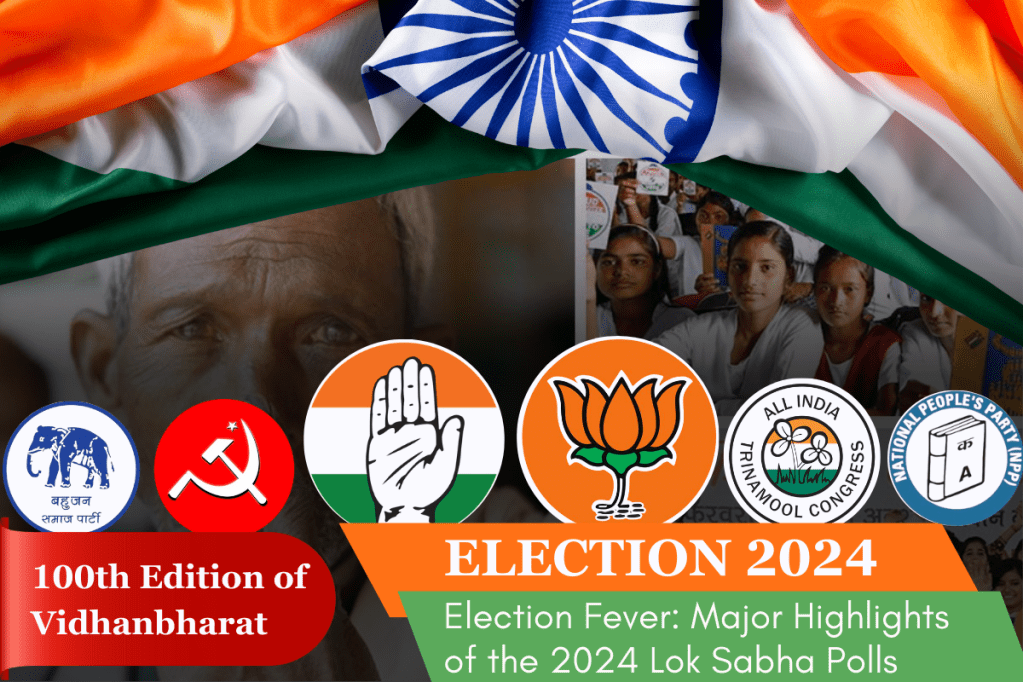
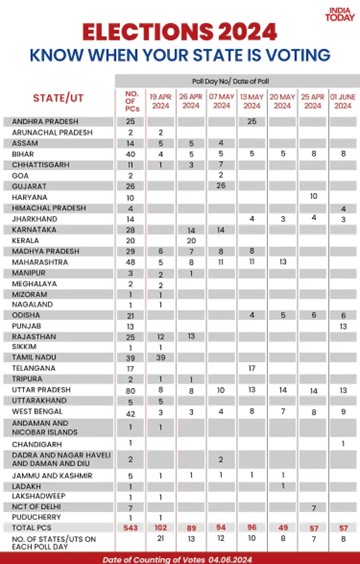
The Chief Election Commissioner, Rajiv Kumar, announced the highly anticipated schedule for the upcoming 18th Lok Sabha elections, along with Assembly seats in Andhra Pradesh, Arunachal Pradesh, Odisha, and Sikkim. Additionally, by-elections will be conducted in Bihar, Gujarat, Haryana, Jharkhand, Uttar Pradesh, Karnataka, Tamil Nadu, and Tripura.
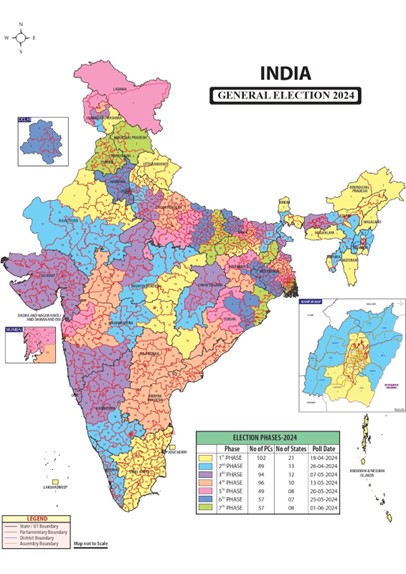
The elections will encompass 543 Lok Sabha parliamentary constituencies, comprising 412 general seats, 84 reserved for Scheduled Castes (SC), and 47 reserved for Scheduled Tribes (ST). Scheduled between April 19 and June 1, the elections will unfold across seven phases. Simultaneously, Assembly polls for the mentioned four states will occur. The crucial final counting is scheduled for June 4, 2024.
Statistical Overview of the Voters
Approximately 960 million individuals out of a population of 1.4 billion are eligible to participate in the eagerly awaited elections, which are expected to span a month for completion.
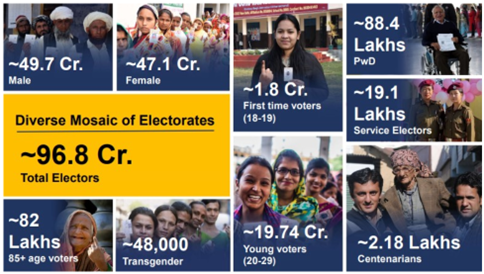
- There are 97.8 crore eligible voters of which 49.72 crore are male voters and 47.1 crore are female voters.
- There are at least 1.82 crore first-time voters in the electoral rolls.
- There are 19.74 crore young voters in the 20 to 29 age group.
- Over 48,000 transgenders are eligible to vote in the upcoming Lok Sabha elections.
- More than 2 lakh registered voters were over 100 years of age.
- A total of 88.4 lakh people with disabilities have been registered in the electoral roll.
- More than 19 lakh service electors, 2.18 crore centenarian voters and around 82 lakh voters are 85+ years old in this election.
Statistical Overview of the Election Resources
- Over 2,100 general, police, and expenditure observers are being deployed for elections.
- Over 1.5 crore polling officials have been deployed and 10.5 lakh polling stations have been set up.
- Over 55 lakh EVMs will be deployed.
- Over 4 lakh vehicles will be used.
- Poll body promises basic facilities like drinking water, toilets, signage, ramp/wheelchair, help desk, voter facilitation center, and sufficient light at all the polling stations.
- Furthermore, the Commission shall deploy Voter Verifiable Paper Audit Trail (VVPAT) along with Electronic Voting Machine (EVM) at every polling station in the General Elections to Lok Sabha and the Legislative Assemblies of Andhra Pradesh, Arunachal Pradesh, Odisha and Sikkim to enhance the transparency and credibility of the election process as VVPAT allows the voter to verify his/her vote. Arrangements have already been made to ensure availability of an adequate number of EVMs and VVPATs for the smooth conduct of elections
Election Expenses for Candidates:
Loksabha: The Government of India has updated the election expenses ceiling for candidates through a notification dated January 6th, 2022. According to the new ceilings, the maximum allowable election expenses for a Parliamentary Constituency are set at Rs. 95.00 lakh per candidate for all States except Arunachal Pradesh, Goa, and Sikkim, where it stands at Rs. 75.00 lakh per candidate. In the case of Union Territories, the maximum limit for NCT of Delhi and Jammu & Kashmir is Rs. 95.00 lakh per candidate, while for other UTs, it is Rs. 75.00 lakh per candidate.
Vidhan Sabha: Furthermore, the expense limit for Assembly Constituencies in Andhra Pradesh and Odisha is Rs. 40.00 lakh per candidate, whereas in Arunachal Pradesh and Sikkim, it is Rs. 28.00 lakh per candidate.
National Political Parties in the Lok Sabha
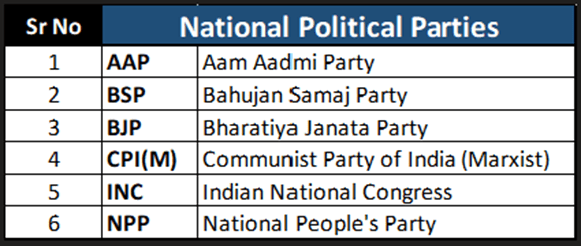
As on date we have 06 Recognized National Parties and 58 Recognized State Political Parties which are already having ear-marked symbols as per the ECI. Recognized state Political Parties include parties like TMC, CPI, JDS, JDU, AIADMK, DMK, LJP(RV), NPF, NCP, RJD, TDP, AIMIM, AIUDF, AJSU, AD(S), AGP, BRS, BJD, DMDK, INLD, IUML, JKNC, JKPDP, JJP, JMM, MNS, MNF, SP, SAD, Shivsena, SDF, SKM, TMP, YSRCP ZNP, ZPM, etc.
State Elections
Simultaneously, state elections are also scheduled to be held in the states of Arunachal Pradesh, Andhra Pradesh, Sikkim and Odisha. Arunachal Pradesh and Sikkim Assembly elections for 60 and 40 seats are going to be held in the first phase only. Andhra Pradesh Assembly elections for 175 seats will be held in the fourth and single phase. Assembly elections in Odisha for 147 seats are going to take place in four phases from fourth phase to seventh phase. The results of the 322 assembly seats in Andhra Pradesh and Odisha along with 543 Lok Sabha seats will be declared on June 4, 2024. And the results of the 100 assembly seats of Sikkim and Arunachal Pradesh assembly will be declared on 2nd June as the term of both the Legislative Assemblies is due to expire on 2nd June 2024.
Electoral History of Lok Sabha in brief
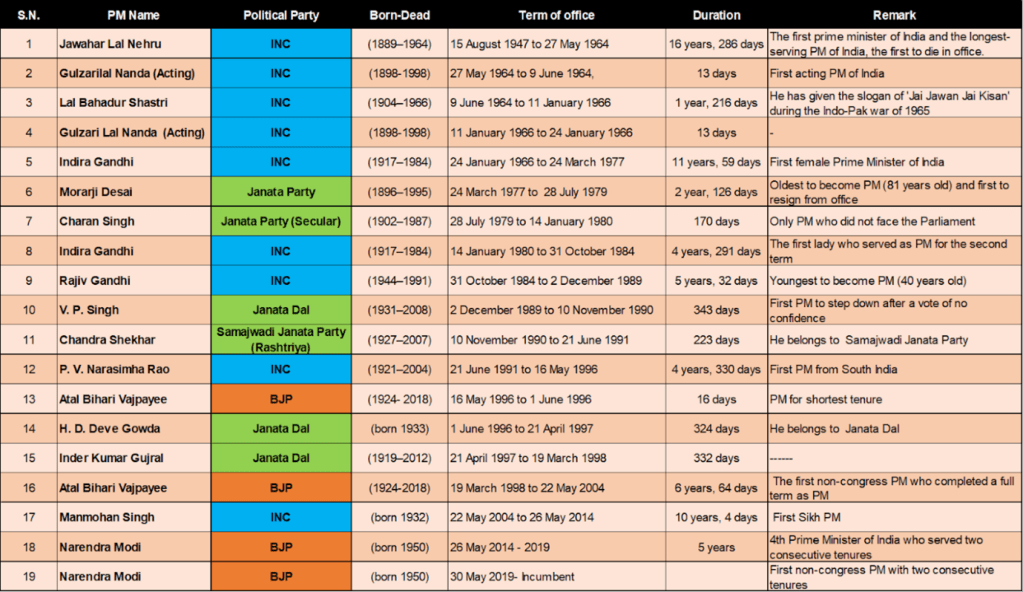
Since independence there have been 17 Lok Sabha Elections. The upcoming Lok Sabha Election will be the 18th one. The 2019 Lok Sabha election has recorded the highest turnout of 67.40% in which BJP emerged victorious by winning 303/543 seats in the Lok Sabha. Shri. Narendra Modi was re-elected as the Prime Minister of India. It can be seen from the electoral history that only two Political parties were able to dominate the national politics in Bharat and they were the BJP and the Congress. Since Independence, Congress party gave six Prime Ministers to the Nation with the record of ruling the Centre for the longest period of around 54 years, while BJP was able to give two PMs to the Nation for a term of 15 years. Janata Party dominated the Lok Sabha election results in 1977 and Janata Dal also got opportunities in 1989 and 1996 to form the governments, but those governments could not complete their term and Lok Sabha was dissolved prematurely in these cases. Similarly, in 1998, BJP formed the government after the Lok Sabha election but couldn’t sustain it for a full five years.

References:
- https://www.news18.com/elections/election-commission-of-india-rajiv-kumar-important-numbers-2024-lok-sabha-polls-voters-list-registered-voters-polling-booths-8817954.html
- https://timesofindia.indiatimes.com/india/lok-sabha-election-2024-check-voting-dates-full-schedule/articleshow/108546306.cms.
- https://www.thehindu.com/elections/lok-sabha/general-elections-2024-full-schedule/article67953556.ece
- https://eci.gov.in/candidate-political-parties/list-of-political-parties/
- https://www.eci.gov.in/
- https://www.eci.gov.in/general-elections
- https://www.jagranjosh.com/general-knowledge/list-of-all-prime-ministers-of-india-1473165149-1



 Vidhan Bharat
Leave a comment