
Recently, the Information Technology (IT) Ministry has sent an advisory to Artificial Intelligence (AI) companies like Google and OpenAI, as well as to those running such platforms, including foundation models and wrappers. The advisory states that their services should not generate responses that are illegal under Indian laws or threaten the integrity of the electoral processes.
Google’s AI platform Gemini recently came under fire from the Ministry of Electronics and Information Technology (MeitY) for answers generated by the platform in response to questions about Prime Minister Narendra Modi. Minister of State for Electronics and IT, Rajiv Chandrashekhar, said that the advisory is a signal for future legislative action that India will undertake to regulate generative AI platforms. The notice was sent to all intermediaries, including Google and OpenAI, on March 1, 2024.
Today, the use of mobile phones embedded with the internet has increased manifold globally, including in countries like India. Additionally, with advancements in technology like 5G and Wi-Fi, the use of AI on mobile phones has increased. The efficient use of AI has enhanced the productivity of many sectors. However, it is important to acknowledge that, along with its benefits, AI also poses disadvantages.
This year is marked by global elections, including major countries like India and America. Against this backdrop, misinformation spread by AI during elections is emerging as a serious concern. For example, India’s Ola Krutrim AI has its political neutrality at 7 out of 10 when it should be a perfect 10/10.1 This means that even a 30% error or misinformation can cause chaos in India’s diverse religious population. Even Prime Minister Narendra Modi has warned his ministers to be cautious regarding deep fakes and misinformation. 2
The following figure depicts national risk to India in the context of the upcoming elections.
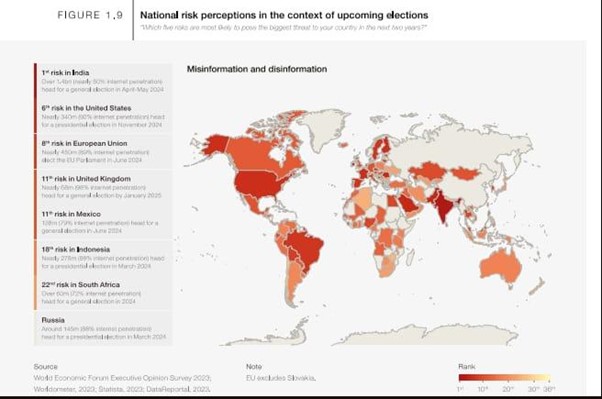
India, being a diverse country in terms of religion and caste, is susceptible to the negative impact of deepfakes and AI-generated rumors. Recently, an AI-generated fake speech video was created of the Tamil Nadu veteran leader M. Karunanidhi.4 Such speeches and videos can often be generated to impress the voters. This shows how Indian elections are vulnerable to AI because of its cheap internet and huge penetration.
In February 2024, representatives from OpenAI, the AI firm that developed ChatGPT, met with officials from the Election Commission of India (ECI) to ensure that its popular platform is not misused in the upcoming Lok Sabha election, and to find ways to collaborate with the ECI. 5
AI has the potential to transform the working culture of many sectors. To fully utilize the potential of AI, laws related to AI need to be updated and implemented efficiently. Many countries are amending their laws; for instance, China made amendments in January 2023, and the US included deep fakes under cybersecurity laws. Several high-ranking bureaucrats have also recommended that the Indian government amend the IT Act 2000. The government is also planning to pass a law to regulate AI misuse by developing a draft regulatory framework for AI by June-July 2024.
In essence, the formulation and implementation of comprehensive laws and regulations must be ensured, especially during sensitive processes like elections, which are crucial for democracy.
References:
- Barik, S. (2022, May 1). Ola’s Krutrim AI rate itself on political neutrality, religious polarisation to BJP. The Indian Express. https://indianexpress.com/article/technology/artificial-intelligence/ola-krutrim-ai-rate-itself-political-neutrality-religious-polarisation-to-bjp-9183891/
- Jeelani, G. (2024, March 4). ‘Be cautious,’ PM Modi’s warning to ministers on dangers of deepfakes ahead of Lok Sabha polls 2024. Mint. Retrieved from https://www.livemint.com/politics/news/be-cautious-pm-modis-warning-to-ministers-on-dangers-of-deepfakes-ahead-of-lok-sabha-polls-2024-11709517867668.html
- World Economic Forum. (2024). The Global Risks Report 2024: 19th edition. Retrieved from https://www3.weforum.org/docs/WEF_The_Global_Risks_Report_2024.pdf
- Ram, A. (2024, February 19). Dead man walking: How AI will bring back past leaders to future polls. Times of India. Retrieved from https://timesofindia.indiatimes.com/blogs/chennaitalkies/dead-man-walking-how-ai-will-bring-back-past-leaders-to-future-polls/?source=app&frmapp=yes
- Krishan, N. & Deep, A. (2022, February 25). Amid fears of AI misuse in upcoming poll, OpenAI executives met Election Commission officials in February. The Hindu. Retrieved from https://www.thehindu.com/elections/lok-sabha/amid-fears-of-ai-misuse-in-upcoming-poll-openai-executives-met-election-commission-officials-in-february/article67929199.ece
Meet Our Guest Author
Bhushan Kindarle
BSc Economics (Hons.), Second Year,
School of Economics, MIT-WPU, Pune.
The views and opinions expressed in this article are those of the author and do
not necessarily reflect the views or positions of Vidhanbharat.


 Vidhan Bharat
Leave a comment