The Lok Sabha election 2024 to elect 543 members of the lower house of parliament has commenced. For a vast country like India, considering its geographical expansion, population density, and sheer massiveness of scale, the general elections are conducted in multiple phases.
The 2024 election will be held in 7 phases, from April 19th to June 1st, 2024. This is the largest election period after the first General Elections in 1951-52.
Phase one
Phase one of this election is the largest of all the phases; it covered 102 Lok Sabha seats, 16.63 crore voters, 1.87 lakh polling stations, and 18 lakh personnel for the smooth conduct of the polls.
Over 16.63 crore voters across were eligible to cast their votes. Amongst the eligible voters, 8.4 crore were male, 8.23 crore were female, and 11,371 were Third gender electors.1
Voter turnout statistics
The first phase of the polling saw a turnout of 65.5% recorded in 102 seats, as against 69.9% in these seats in 2019, a drop of 4.4% based on provisional numbers. The talk is circling the falling in numbers for nationwide voter turnouts and its political implications.
First, let’s take a look at the official figures by the Election Commission of India (as of 7 p.m. on April 19).2
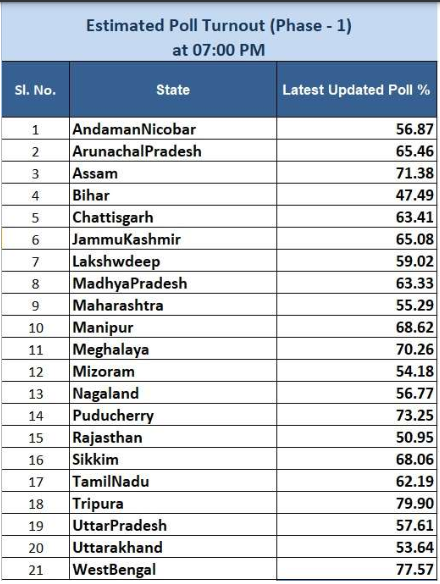
Now we will see comparisons with the 2019 numbers.
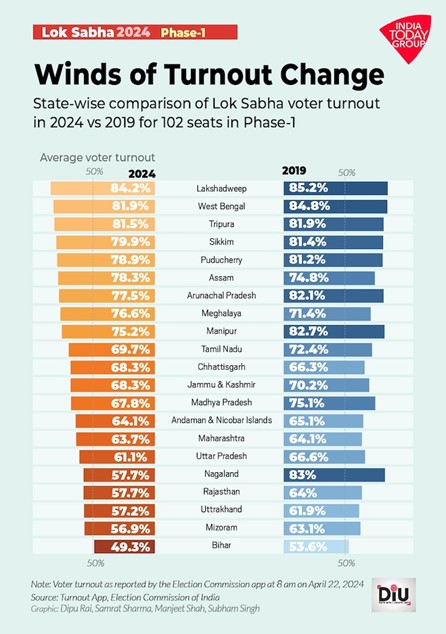
Graphic credit: India Today
We can see in the numbers above, there has been a significant drop in the number of votes cast across the same constituencies compared to the same in 2019. Especially in large states like Maharashtra, Rajasthan, and Uttar Pradesh, where this difference is as large as 5-7%. Some smaller states, such as Nagaland, even witnessed a double-digit drop. This has triggered a debate about who will be the beneficiary of the drop in voters.
Some factors are attributed to the drop in voter turnout, such as a lack of enthusiasm among the voters. The sudden heat wave that gripped the hinterlands of the nation is also considered a factor. Some media houses have even debated this as a sign of apathy towards the election process due to the divisive nature of politics. 3
The Election Commission of India (ECI) has termed the decline “significant” but not “alarming” and expressed concern over the fall in polling percentages. Long lines at polling booths in scorching heat and a lack of comfort for people willing to cast votes can factor in; however, political experts are also hinting towards a general apathy amongst the voters as people in India are losing interest due to the incessant bombardment of divisive as well as abusive campaigning by political parties, along with a lack of on-ground canvassing.
Even the big parties with significant cadres at booth level have failed to get their numbers up. Here we shall see a region-wise analysis of the voting pattern and get an idea of the consequences for each contesting party.
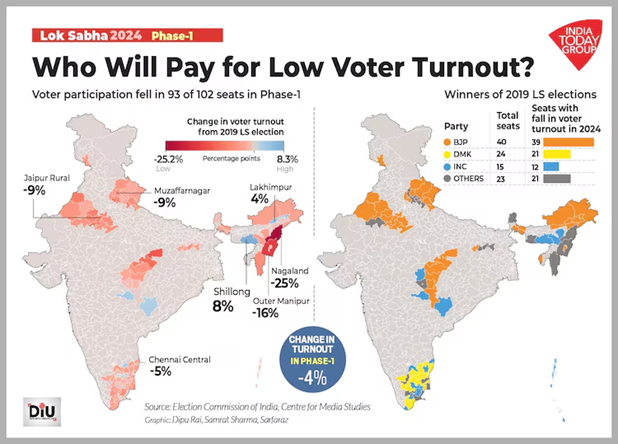
Graphic credit: India Today
Region-wise analysis
North:
Starting with northern India, the Jammu and Kashmir region has seen a jump of 2% in voter turnout. This is the first Lok Sabha election in Jammu and Kashmir, and Ladakh after the abrogation of Article 370.
Among the concerning topics for major parties; one could be the fall in voting in Western UP. In UP, voter turnout in 2019 was 63.92, which has come down to 60.25 % this year. Western UP and Uttarakhand are considered strongholds for the BJP; therefore, a fall in voting is naturally considered worrying for its aspirations. Constituencies like Pilbhit, Rampur, and Mujjaffarnagar have seen a drop of 8-10% in voter turnout. This was the belt of the Kisan Andolan. Bihar has seen a drop of 4%, which is being touted as the reaction of voters to the flip-flop politics in the state.
Northeast:
Arunachal Pradesh has shown a drop of 4%; however, the assembly election is also due in the next phase, so its impact remains to be seen. Assam, however, has been an outlier, with a jump of 4% in turnout. One of the main reasons for this phenomenon is said to be the decision to implement CAA, which has galvanized different groups with their positions on this Act. After the violence last year, and amidst ongoing tensions, voter turnout in Manipur has fallen significantly. Including a few incidents of poll violence, Manipur state was a factor of worry in terms of voter participation. On the other hand, Tripura saw the highest of the nation’s turnout at 80%. Nagaland has seen a large drop due to boycotts in a few places, which can be a cause for concern.
East
West Bengal, which had only three seats in this phase; except for sporadic events of poll violence, saw a difference of three percent less than the last iteration.
Central
Madhya Pradesh has seen the steepest drop of 8% against the national average. Even though the factor behind this change is considered to be the hot weather, both the national parties in contention in the state are interpreting it to their advantage. Chhindwara in MP, where a keen contest is expected between the BJP and Congress, recorded the highest 79.83 percent voting. Chhattisgarh, however, was an exception, with an increase of 2% in voting despite the Naxal incident in Bastar.
West
Phase 1 of 2024 didn’t have many seats from Western India. In Maharashtra, the prestigious seat of Nagpur saw a dip in voting. Nagpur seat saw the lowest turnout of all the seats in Maharashtra at 49%. In other seats, Infray and Fray, Gadchiroli-Chimur topped the voter turnout with 66.27%, followed by 55.87% in Bhandara-Gondia and 55.11% in Chandrapur. Ramtek saw a turnout of 52.38. This constituency has a mix of Nagpur’s semi-urban and rural voters and was previously represented by former Prime Minister Bharat Ratna P.V. Narasimha Rao in 1984 and 1989.
In Rajasthan, in the constituencies of Bikaner and Alwar, two cabinet ministers are contesting. Across Rajasthan, polling stood at 57.7%, against 64% in 2019.
South
One of the significant highlights of Phase 1 could be the voting in Tamil Nadu. Out of 24 seats won by DMK in 2019, 21 seats have seen a dip in voter turnout. The Chennai South Lok Sabha seat has seen a significant drop of 4 percent. The urban apathy toward voting is a cause for concern. In Coimbatore, another prestigious seat in the state, the turnout was 71.7%, the highest in 20 years, against 63.84% in 2019. 10
In the rest of Tamil Nadu, the voter turnout remains lower than in the 2019 election, with a difference of 3%. Seats in Andaman and Nicobar, as well as Lakshadweep, were also in the fray, where a slight dip in voting percentage had taken place. Members of the Shompen tribe, part of Particularly Vulnerable Tribal Groups (PVTGs), cast votes for the first time in the Andaman and Nicobar Islands. 11
Conclusion
This is a question to ask; which electoral alliance benefits more from a lower turnout? The records indicate that out of the 10 occasions when turnout increased compared to the last election, the incumbents benefited 6 times and were at a loss 4 times. Hence, the government was repeated 60% of the time. In 6 elections when the voters’ turnout had declined, the incumbent had lost 4 times and won 2 times.
In 2019, there was a significant jump in voter turnout. However, so far, a lack of intense booth-level campaigning and heat waves have led to less voting. We can also expect changes in booth-level strategies by parties from the lessons of the first phase.
A lower voting percentage shows voter apathy towards governance. Which leads to less accountability.
Political competition in an electoral democracy is meant to make politicians accountable for the improvement of the lives and livelihoods of people. Unworthy politicians can be voted out if people find them ineffective. Thus, this is a significant factor in the electoral process and the overall health of democracy. Let us hope that in the subsequent phases, we see a larger voter turnout.
References:
- Press Note. Election Commission of India. Dated: 18.04.2024 https://elections24.eci.gov.in/docs/Iy4WJ2RxE9.pdf
- Press Note. Election Commission of India. Dated: 19.04.2024 https://www.eci.gov.in/eci-backend/public/api/download?url=LMAhAK6sOPBp%2FNFF0iRfXbEB1EVSLT41NNLRjYNJJP1KivrUxbfqkDatmHy12e%2Fzye%2BFD1PRcKxhOuiYZ2Ra30zsZVuncZbKMyY%2FE405%2FpscS%2Fh9mmIfBo6XZVb4k%2FLSCSv%2B1yJkuMeCkTzY9fhBvw%3D%3D
- Chetan Chauhan, HT(2024). Ecostani | Voter apathy or political discontent? What low voter turnout means for 2024 polls https://www.hindustantimes.com/opinion/ecostani-voter-apathy-or-political-discontent-what-low-voter-turnout-means-for-2024-polls-101713874456354.html
- Amitabh Tiwari, The Quint(2024). Lok Sabha Elections 2024: What Explains the Low Voter Turnout During Phase One? https://www.thequint.com/opinion/lok-sabha-elections-phase-one-voting-low-voter-turnout-bjp-congress-state-wise-analysis
- Dipu Rai, Samarat Sharma, India Today(2024). Lok Sabha Elections 2024: What Explains the Low Voter Turnout During Phase One?https://www.indiatoday.in/diu/story/lok-sabha-elections-phase-1-elections-voter-turnout-falls-diu-2530278-2024-04-22
- ET Online (2024). Lok Sabha Election 2024: Bihar records lowest voter turnout at 47.74%; Tripura sees highest turnout at 80.06% in first phase https://economictimes.indiatimes.com/news/elections/lok-sabha/india/lok-sabha-election-2024-tamil-nadu-up-voter-turnout-at-12-west-bengal-at-15-till-9-am/articleshow/109421695.cms
- Indranil De. Indian Express (2024) The power of a vote: Is there a link between voter turnout and progress?https://indianexpress.com/article/opinion/columns/lok-sabha-elections-voter-turnout-9286009/
- Lakshmi Subramanian. The Week (2024). Why Tamil Nadu recorded a low voter turnout this Lok Sabha elections https://www.theweek.in/news/india/2024/04/21/why-tamil-nadu-recorded-a-low-voter-turnout-this-lok-sabha-elections.html
- Muskaan Sharma. NDTV(2024). Lok Sabha Elections Phase 1 2024 Highlights: Nearly 64% Voter Turnout In Phase 1 Lok Sabha Polls https://www.ndtv.com/india-news/lok-sabha-election-2024-phase-1-live-updates-voting-to-begin-at-7-am-5471946
- Moneycontrol News (2024). Lok Sabha Elections 2024: Coimbatore records highest voter turnout in last 20 years at 71.7% https://www.moneycontrol.com/elections/lok-sabha-election/lok-sabha-elections-2024-coimbatore-records-highest-voter-turnout-in-last-20-years-at-71-7-article-12678461.html
- PTI. X(formerly known as Twitter) (2024). https://twitter.com/PTI_News/status/1781352527063126161?ref_src=twsrc%5Etfw%7Ctwcamp%5Etweetembed%7Ctwterm%5E1781352527063126161%7Ctwgr%5Ec75e77edf2b86175d0072bccd90589c0aa190dfa%7Ctwcon%5Es1_&ref_url=https%3A%2F%2Fwww.wionews.com%2Findia-news%2Flok-sabha-election-2024-live-voting-phase-1-up-rajasthan-bihar-mp-maharashtra-tamil-nadu-nagaland-sikkim-mizoram-712699



 Vidhan Bharat
Leave a comment