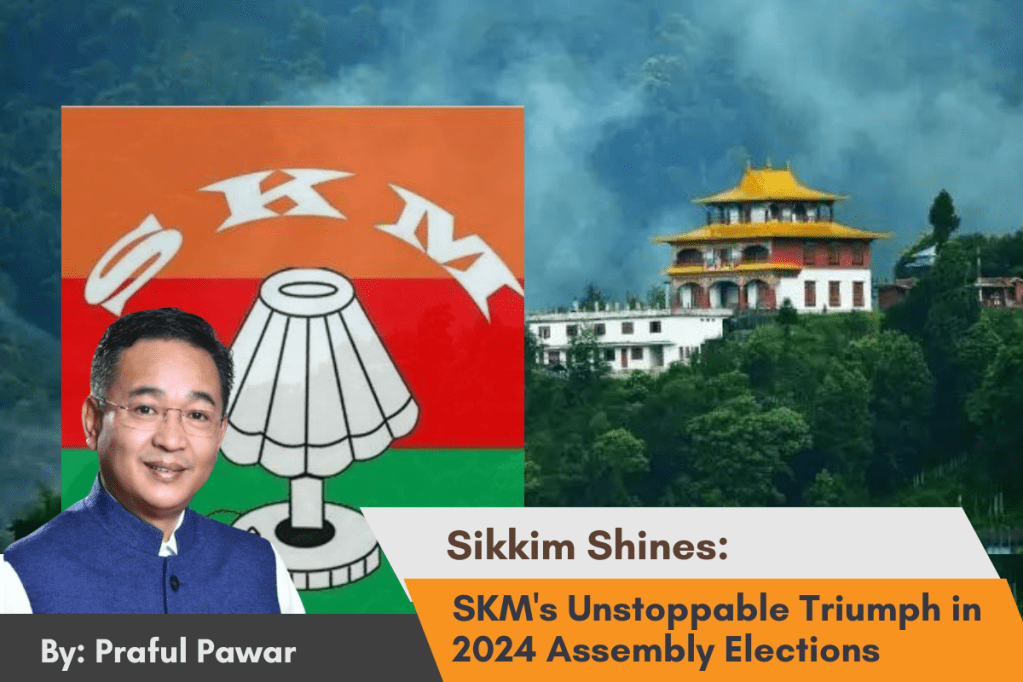
In April, while the nation’s attention was predominantly on the Lok Sabha elections, a significant political event unfolded in the northeastern state of Sikkim. Amidst the buzz surrounding the parliamentary polls, Sikkim Krantikari Morcha (SKM) achieved a remarkable feat by securing a landslide victory in the state assembly elections. This triumph marked a crucial moment in Sikkim’s political landscape. SKM’s resounding win reflected the electorate’s desire for change and the party’s effective campaign strategies, which resonated with the voters’ aspirations and concerns. The success of SKM not only underscored a shift in the state’s political dynamics but also showcased the vibrancy and diversity of India’s democratic processes. Despite the overarching focus on the national elections, the state assembly results in Sikkim highlighted the importance of regional political movements and their impact on local governance and development.
The Sikkim Krantikari Morcha (SKM), or Sikkim Revolutionary Front, is a key political party in Sikkim, in power since 2019. Founded by PS Golay on February 4, 2013, after he broke away from the Sikkim Democratic Front (SDF) and its leader Pawan Kumar Chamling, SKM quickly became a significant force. In the 2014 Sikkim Legislative Assembly elections, SKM contested all 32 constituencies and secured 10 seats, becoming the second-largest party. By 2017, Kunga Nima Lepcha was elected Acting President, MP Subba, Navin Karki as Working Presidents, and Arun Upreti as Secretary General. Although SKM considered an alliance with the Bharatiya Janata Party (BJP) before the 2019 elections, they decided to contest independently and later joined the National Democratic Alliance on May 26, 2019. In the 2019 elections, SKM won 17 seats, ending Chamling’s 25-year rule.1
The Sikkim Krantikari Morcha (SKM) secured a second consecutive term in Sikkim by winning 31 out of 32 seats in the 2024 assembly elections. The elections were held on April 19, coinciding with the first phase of the Lok Sabha elections. An estimated 80 percent of the 4.64 lakh voters participated in the election.2 Key candidates in the race included Sikkim Chief Minister Prem Singh Tamang, his wife Krishna Kumari Rai, former CM Pawan Kumar Chamling, and ex-footballer Bhaichung Bhutia. SKM’s victory marks a decisive win over the opposition Sikkim Democratic Front (SDF), BJP, Congress, and Citizen Action Party-Sikkim (CAP-S). The substantial mandate reflects strong support for SKM in Sikkim, consolidating its position in the state’s political landscape.
Analysts say that SKM has implemented several public welfare schemes in Sikkim which has helped them in winning the elections. SKM also claims to have succeeded in removing the tag of ‘foreigners’ from the Nepali community of Sikkim. Recently, on the occasion of 5 years of government in Sikkim, SKM announced its achievements.3 The temporary employment of teachers, deputy professors, etc. is also seen as an achievement of SKM. The Tamang government has also raised the wages of workers to 15,000 Indian rupees per month. Similarly, the plan to teach MBBS to 50 Sikkimese students who are below the poverty line is also popular. Furthermore, one-year maternity leave, various support and subsidies for students and farmers are also liked by the Sikkimese people.
To conclude, the overwhelming support for SKM, amidst competition from SDF, BJP, Congress, and CAP-S, reflects a clear endorsement of SKM’s vision in addition to highlighting the importance of regional parties. Sikkim’s historical context, from its early days under the Namgyal dynasty, through British protectorate status, to becoming an Indian state in 1975, provides a rich backdrop to its contemporary political developments. SKM’s sustained success signifies a stable and forward-looking political era for Sikkim, promising continued progress and development for the Himalayan state.
References:
- India Today. (2024, June 2). Sikkim Krantikari Morcha: What is SKM Political Party? Retrieved from: https://www.indiatoday.in/elections/story/sikkim-krantikari-morcha-what-is-skm-political-party-2546963-2024-06-02
- The Economic Times. (2024, June 2). Sikkim Elections Winners Losers List: SKM secures 2nd consecutive win. Here is the full list of winners. Retrieved from: https://economictimes.indiatimes.com/news/elections/assembly-elections/sikkim/sikkim-assembly-elections-2024-results-constituencies-wise-winners-and-losers-list/articleshow/110631220.cms?from=mdr
- संवाददातक. (2024, June 2). SKM’s magic continued in Sikkim: victory in 31 out of 32 seats. विश्व – कान्तिपुर समाचार. Retrieved from: https://ekantipur.com/en/world/2024/06/02/skms-magic-continued-in-sikkim-victory-in-31-out-of-32-seats-58-07.html





 Vidhan Bharat
Leave a comment