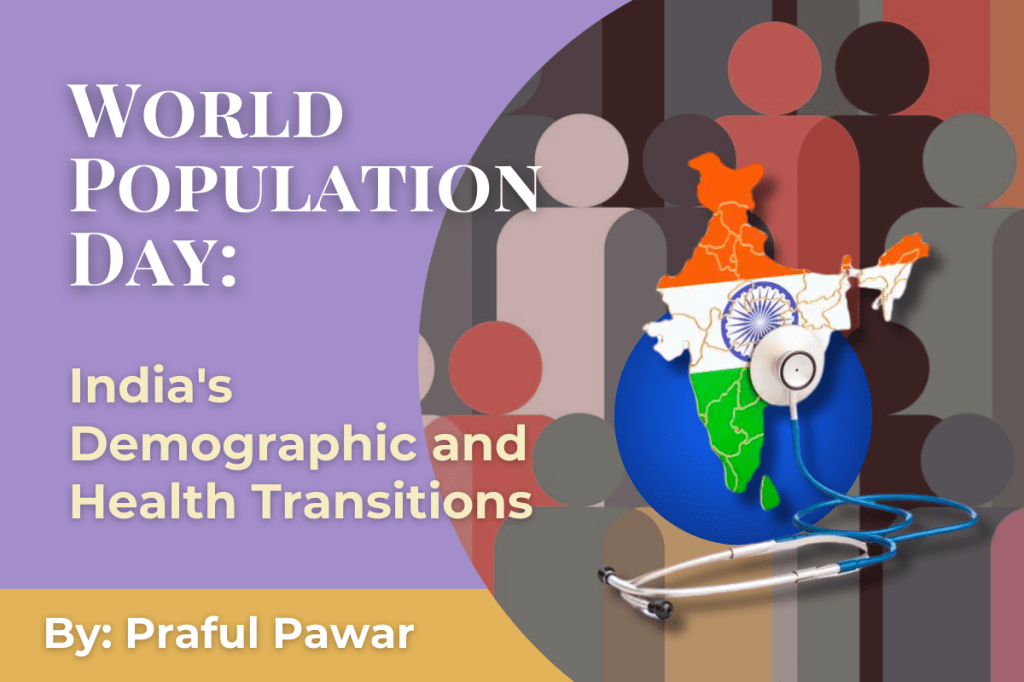
World Population Day is celebrated annually on July 11 to highlight urgent and important population issues. In 1989, the Governing Council of the UN Development Program (UNDP) established the Day as a result of the interest generated by the Day of Five Billion, observed on July 11, 1987.1 India has been said to surpass China as the most populous country in the world and is currently experiencing a significant demographic transition. The next census exercise, pending since 2021, will provide accurate population numbers to us. The demographic transition leads to emerging health challenges, making it crucial to reevaluate the current healthcare conditions to formulate new policies. As David Satcher once said, “Population health is about more than healthcare; it is about creating the conditions in which people can be healthy.”
Demographic Transition:
According to the United Nations, in April 2023, India will overtake China as the world’s most populous country.2 India is also undergoing a demographic transition, with the proportion of people aged 65 years and above expected to double from 6.6% in 2020 to 13.8% of the total population by 2050. Currently, one-third of India’s population is in the 10-24 age group and the working age population is expected to grow by roughly 9.7 million per year during 2021-31. Although 70% of India’s population lives in rural areas, this proportion is projected to change dramatically with rapid urbanization in India. By 2040-50, urban India will constitute 50% of the total population, with a doubling of the urban population from 461 million to 877 million by 2050.3 Meanwhile, in recent decades, population growth in India has been slowing down due to falling fertility rates. However, with falling fertility and increased longevity comes population aging. This demographic transition poses serious health challenges for policymakers.
Health Transition:
India’s transition in the health sector has been remarkable. It has achieved breakthrough public health milestones by eradicating smallpox by 1977, yaws by 2004, and polio by 2014. The world is well versed in India’s success in reducing mortality and improving life expectancy. Once an importer of medicinal drugs, it is now justifiably called the “world’s pharmacy” with its success in the overseas pharmaceutical market with the help of companies like Ranbaxy and Dr. Reddy’s Laboratory (DRL).4 Over the past 40 years or more, the nation’s once almost non-existent pharmaceutical industry has experienced rapid expansion and transformation, enabling it to compete on a global scale by manufacturing high-class generic medications.
Health Challenges:
Despite India’s remarkable progress in the health sector, there are also some challenges. The healthcare needs of aging populations pose socio-economic challenges for the elderly, while also putting a strain on the health system with the age-related transition towards non-communicable diseases (NCDs). The rising number of elderly people will require greater provision of elderly care services such as nursing homes, day-care centers, outpatient services, or intensive care, depending on the health issue.
With rapid increases in urban populations, India will need to provide adequate urban health facilities, especially for the urban poor. India’s 2011 census found that 13.7 million households live in slums in India. Furthermore, urban populations are facing a greater share of the burden of NCDs resulting from hypertension, unhealthy lifestyles, pollution, and greater risks of road crashes and other injuries. Urbanization is also one of the leading causes of the increasing burden of injuries as a share of the total disease burden in India. To address these health challenges, it is necessary to reevaluate current health policies.
Current Health Policies:
India’s current health policies address key areas such as population growth, elderly care, urban health, and Non-Communicable Diseases (NCDs). The National Health Policy (NHP) 2017 emphasizes universal health coverage to manage population growth and improve health outcomes. It recognizes the unique health needs of the elderly, aiming to provide accessible and affordable healthcare services. The National Urban Health Mission (NUHM), launched in 2013, targets the health needs of the urban poor and marginalized, improving healthcare access and quality in urban areas. For NCDs, the NHP 2017 and initiatives like Ayushman Bharat Yojana provide comprehensive primary healthcare services, including screening and management of NCDs, through Health and Wellness Centers (HWCs).5 These current policies reflect India’s commitment to improving health outcomes across diverse demographics. However, these policies are insufficient to address the health challenges mentioned above, so there is a need to formulate and implement additional policies.
Way Forward:
As of now, in India, healthcare expenses are high, making it difficult for the poor to afford necessary services, while the rich can easily access elite healthcare. The healthcare system’s quality is compromised due to overpopulation and overconsumption, creating societal imbalances. To address this situation, cheap and effective healthcare policies are needed for the poor. Furthermore, promoting preventive care through awareness programs and regular check-ups is essential, as is leveraging telemedicine for remote consultations. Training more healthcare workers and encouraging public-private partnerships can expand healthcare infrastructure. Additionally, implementing regulations to reduce pollution and establishing a robust feedback system to continuously improve policies are crucial steps. A student of BJ Medical College, Pune rightly put it as “To achieve true fairness and quality implementation of healthcare facilities, emphasize equitable distribution instead of equality.” Therefore, developing targeted programs for the urban poor, especially those in slums, will create a more equitable and effective healthcare system for all.
Reference:
- Hub, I. S. K. (n.d.). Event: World Population Day 2024 | SDG Knowledge Hub | IISD. Retrieved from https://sdg.iisd.org/events/world-population-day-2024/
- UN DESA Policy Brief No. 153: India overtakes China as the world’s most populous country | Department of Economic and Social Affairs. (n.d.). Retrieved from https://www.un.org/development/desa/dpad/publication/un-desa-policy-brief-no-153-india-overtakes-china-as-the-worlds-most-populous-country/
- Center for Policy Impact in Global Health. (2022). India’s health transitions: Country impact profile. Retrieved from https://centerforpolicyimpact.org/wp-content/uploads/sites/18/2022/04/India-Country-Profile-Final-Version.pdf
- Sahoo, P. M., Rout, H. S., & Jakovljevic, M. (2023). Consequences of India’s population aging to its healthcare financing and provision. Journal of Medical Economics, 26(1), 308–315. Retrieved from https://doi.org/10.1080/13696998.2023.2178164
- Suri, D. (2024, April 5). Enhancing population health: India’s policies and programmes. Observer Research Foundation. Retrieved from https://www.orfonline.org/expert-speak/enhancing-population-health-india-s-policies-and-programmes



 Vidhan Bharat
Leave a comment