Former PM A.B. Vajpayee once famously said, ‘You can change your friends but not your neighbors’. In light of this statement, India’s ‘Neighbourhood First policy’ guides its approach towards the management of relations with countries in its immediate neighborhood, that is, Afghanistan, Bangladesh, Bhutan, Maldives, Myanmar, Nepal, Pakistan, and Sri Lanka.1 The Neighbourhood First policy is aimed at enhancing physical, digital, and people-to-people connectivity across the region, as well as enlarging trade and commerce. However, the region has been facing significant political and economic instability over the last three years, creating substantial hindrances to India’s Neighbourhood First policy. In light of these challenging situations, it is important to brainstorm on India’s approach to tackling them.
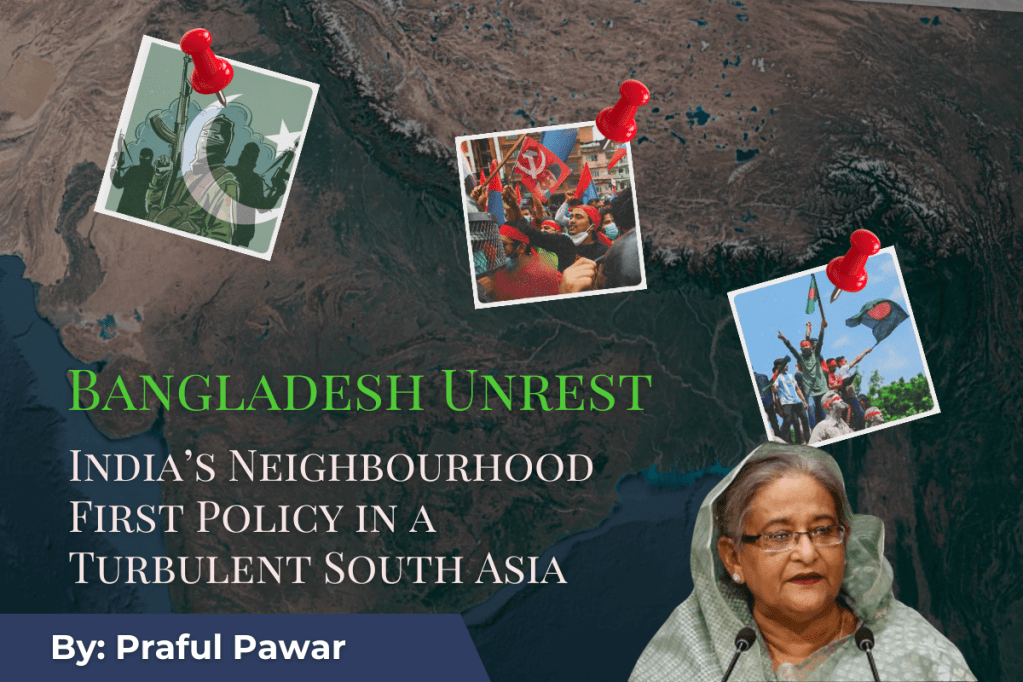
Recently, Bangladesh’s Prime Minister Sheikh Hasina resigned, which ended her 15 years in power as thousands of protesters defied a military curfew and stormed her official residence.2 What started as a protest against a quota system for government jobs in Bangladesh has turned into widespread looting and rioting across the country, with the minority community, mainly Hindus, coming under attack, including the Indira Gandhi Cultural Centre, which promotes cultural exchange between India and Bangladesh.3 The Hasina-led government was replaced by an interim government, and 84-year-old Nobel laureate Muhammad Yunus was named its Chief Adviser. This marked a significant shift in the political landscape of South Asia, which has seen profound changes over the past three years.
In August 2021, the Taliban’s takeover of Afghanistan marked a major geopolitical upheaval, which influenced regional security dynamics.4 Although India has managed to maintain cordial relations with humanitarian assistance, its significant investments in Afghanistan’s development remain at risk as its strategic influence has waned. Likewise, in Pakistan, the ouster of Prime Minister Imran Khan in April 2022 introduced new political uncertainties, with recent terrorist attacks in the various districts of Jammu and Kashmir that are highly suspected to be sponsored by Pakistan, further strained relations.
On the other hand, Sri Lanka also experienced massive protests, which led to President Gotabaya Rajapaksa fleeing the country in July 2022 due to severe economic crises and political dissatisfaction. Meanwhile, the election of a pro-China president in the Maldives has led to shifts in foreign policy, with increased calls for reducing the Indian military presence, as highlighted by the ‘India-Out’ campaign.5
Furthermore, Nepal’s political landscape remains complex with its growing economic ties with China, particularly through the Belt and Road Initiative, which is raising concerns in India. Although India-Bhutan relations remain strong, the unresolved Doklam issue involving Bhutan, India, and China continues to be a strategic concern for India. While talking about Myanmar, the military coup and subsequent civil unrest have created complex challenges for India, which include security and humanitarian issues. These particular events from Afghanistan to Bangladesh have significantly altered the political dynamics in South Asia, presenting both challenges and opportunities for India in navigating its regional relationships.
In my previous blog, ‘The Gujral Doctrine in India’s Foreign Policy’, I pointed out how the Gujral Doctrine played an active role in India’s foreign policy at the end of the 20th century, especially to sort out issues of dispute with its neighboring countries and promote cooperation.6 In that sense, India’s neighborhood policy should be based on the principles of Gujral doctrine. This would ensure India’s prominence and strength cannot be isolated from the quality of its relations with its neighbors, and there can be regional growth as well.
In conclusion, as South Asia continues to experience significant political and economic shifts, India’s ability to handle these complexities will define its role as a regional leader. The Neighbourhood First policy must evolve to address the changing landscape, requiring a blend of strategic flexibility and reliable commitment to regional stability. By harnessing its historical ties, cultural connections, and economic influence, India can work to mitigate emerging challenges while promoting cooperation and mutual growth. The success of India’s foreign policy in the region will depend on its capacity to adapt to these new realities, reinforcing its position as a stabilizing force in South Asia.
References:
- Government of India (Ed.). (n.d.). Neighbourhood first policy. Ministry of External Affairs. https://fsi.mea.gov.in/Images/CPV/LS97_00.pdf
- The Hindu Bureau. (2024, August 5). Sheikh Hasina’s resignation: Timeline of Bangladesh student protest. The Hindu. https://www.thehindu.com/news/international/from-protests-to-sheikh-hasina-resignation-timeline-of-bangladesh-student-protest/article68488361.ece
- India Today. (2024b, August 7). Temples burnt, houses attacked: How Hindus have become soft targets in Bangladesh. India Today. https://www.indiatoday.in/india/story/bangladesh-violence-hindus-minorities-attacked-temples-set-on-fire-2577703-2024-08-06
- Saxena, A. (2024, August 6). Afghanistan, Pakistan, Sri Lanka and now Bangladesh: What’s going on in India’s neighbourhood? The Times of India. https://timesofindia.indiatimes.com/world/south-asia/afghanistan-pakistan-sri-lanka-and-now-bangladesh-whats-going-on-in-indias-neighbourhood/articleshow/112314656.cms
- From crisis to cooperation: India’s role in South Asia. (n.d.). Drishti IAS. https://www.drishtiias.com/daily-updates/daily-news-editorials/from-crisis-to-cooperation-india-s-role-in-south-asia
- Pawar, P. (2024, March 29). The Gujral doctrine in India’s foreign policy. Vidhan Bharat. https://vidhanbharat.com/2023/12/28/the-gujral-doctrine-in-indias-foreign-policy/

 Vidhan Bharat
Leave a comment