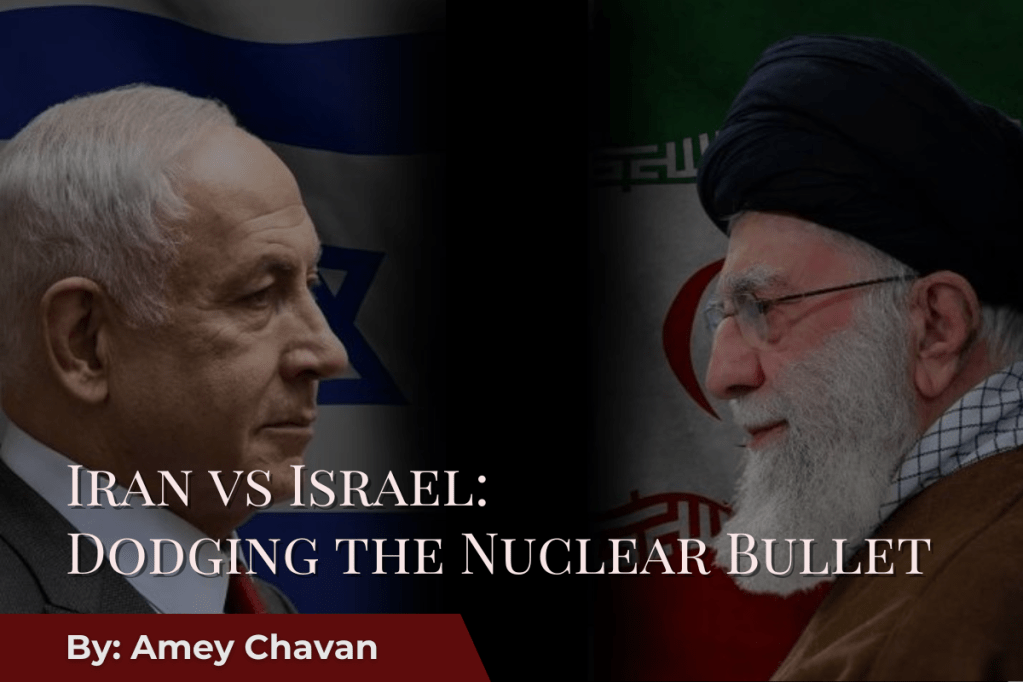
Since its inception Israel has fought, warred, and struggled against the Arab nations. Gaining slow recognition through the Camp David Accords of 1978, the Oslo Accords of 1993, and the Abraham Accords of 2020. Israel and Arab nations have solidified their socio-economic relations across the board. However, Iran has for a long time threatened Israel with violence.
A newborn enemy
Iran’s post-revolution era, after the 1979 Islamic Revolution, Iran severed all diplomatic and commercial ties with Israel, and its theocratic government does not recognize the legitimacy of Israel as a state.
Iran has developed enmity not only with Israel but also with some of the Muslim states largely due to its Shia nature of Muslim faith. Due to its precarious domestic policy anti-western, anti-American sentiment rules dominantly on its diplomacy.
Post-revolution Iran has gone aggressive on its nuclear program. Despite being a signee to the NPT (Nuclear Proliferation Treaty), Iran has moved on with its military-purpose nuclear application development.
This has become a major issue for the US and its allies, especially Israel. For Israel, it is a massive security issue. Apart from the nuclear threat, Iran has infamously funded, trained, and supported various military groups across the Middle East which happily play a proxy to the Shia nation. In the context of Israel; on its western border to the Gaza Strip and the northern border in Lebanon, Iran has nurtured Hamas and Hezbollah respectively. In the words of Middle East analysts, Iran tried to boil the frog of Israel through its proxies.
The poise before the storm
Iran’s nuclear program was thought to be contained while the Obama administration was in place. Even during the Trump administration, the US had negotiated a deal that was agreeable with regional stakeholders including Israel.
Having said that Israel has always done everything in its capacity to bring the project down. From the infamous Stuxnet attack to poisoning Iran’s top nuclear scientists or the assassination of the Chief of the Iranian Revolutionary Guards Corps, Qasem Soleimani; Israel has used every trick in the book to stop the project from advancing.
Iran too has with the use of its proxies, such as Houthis in Yemen; has harassed Israeli trade routes across the Red Sea while keeping pressure on the threat of military infiltration from the north by well-equipped, well-trained Hezbollah (routinely Iran has supplied Hezbollah with drones and missiles) pointing towards kibbutz’s of Israeli colonies.
A road finally taken
After the unprecedented violence of 7th October that has left a deep impact on Israeli consciousness as a nation, and humiliated Mossad for its failure to prevent it; Mossad and IDF in retaliation have gone on full-fledged attack against their enemies. The focus of the IDF is to eliminate the operational capabilities of Hamas to the far extent possible. While Israel is being condemned for its unprecedented scale of violence against the people of Gaza; this merely seems a first of its military objectives.
‘Boiling the Israeli frog’ as the Iranian regime defined it; constituted surrounding Israel with its proxies and slowly strangling into submission. Israel has decided to break this stranglehold. And that too with impunity. But not with a complete disregard for the sentiments of the international community.
Even though Israel has lost cause in terms of humanitarian narratives, it has managed to string up an alliance against what it terms the ‘Axis of Resistance’. Since 2010 Israel has been systematically dismantling this axis of resistance around it. Starting with its bombing raids on Syria (despite Assad being a Moscow ally; and Israel sharing cordial relations with Moscow) it has gone as far as assigning leaders of these militia groups on foreign soil. One of the prominent examples of this would be the killing of Hamas top brass Ismail Haniyeh in Tehran, the Iranian capital.
The dawn before a long night
Israel seems determined more than ever to get rid of Iran’s nuclear project (or at least set it back by a decade) and is willing to do everything in its power to achieve it. The primary reason seems to be the inability of the US under the Biden administration to prevent Iran from progressing with its project. Iran has become more belligerent since Biden came to the helm.
With US elections approaching, if Kamala Harris comes to power, she would likely continue the same approach towards Iran which Israel seems detrimental to its interests. Israel started this dismantling long before the violence of 7th October. This event merely gave Israel a cause to escalate which it successfully did.
After invading Gaza to destroy Hamas it has now turned its eyes on dismantling Hezbollah’s capacity within Lebanon. Wiping out the entire command chain of Hezbollah with a series of covert operations, the IDF has finally crossed Lebanese borders. Surprisingly so far, Hezbollah, one of the most powerful militias in the Middle East has proven incapable of hitting back, which might have surprised Tehran.
Going for the Checkmate
At present, in terms of global geopolitics, Iran is not well placed. Abraham’s accords have successfully neutralized the Arab threat to Israel. With Yemeni Houthi thorn nullified; Saudis have little or no sympathy for the future of Iran.
Iran too has spoiled relations with other important regional powers such as India. The failure of the Chabahar project is fresh in Indian consciousness; considering strong Indo-Israel ties India is unlikely to meddle in the conflict. India has also shown her steadfastness in supporting her allies (with her treatment of Russia during the Russo-Ukrainian conflict); Israel will consider it a regional support to diplomatically counter China and a bridge to Russia in negotiating Iran’s strongest and perhaps only allies.
While Europe is going through its political upheaval and the US is busy in perhaps the most ferociously contested elections in the recent era; Israel is possibly poised to take unprecedented steps. IDF can go as far as striking deep into Iranian territory to take out important Iranian military assets including nuclear ones.
The pager attack followed by strikes on Hezbollah leadership has highlighted the extent of infiltration by Mossad in enemy camps, which can be more dangerous than what meets the eye. Having said this, time is ripe for Israel to eliminate Iran’s nuclear threat at least for the foreseeable future.
However, war regardless of its purpose and method cannot be the solution for the need for peace. Israel has found itself in the middle of a seemingly unending cycle of war and destruction; albeit on foreign soil, can never remain limited to the same. Like fire that engulfs the whole neighborhood, this fire may engulf the whole middle east if conflicts go unchecked.
The state leaders of Arab Nations, such as Crown Prince Mohammed bin Salman Al Saud or Sheikh Tamim bin Hamad Al Thani must step away from their traditional positions and take radical steps to bring stability to the region. While these two nations constantly find themselves engaged in traditional rivalry; for both of their nations to prosper regional stability is essential.
Paradise Now
Amongst the ever burgeoning tensions, Israel must find its way to peace. A war cannot be sustained forever, and for now it seems it has no dearth for enemies. Even though the economy has remained unaffected, the year long conflict has already taken a heavy toll on the consciousness of the common Israelis. Majority of liberal elite citizens are relocating to the US, Europe or even other non-traditional destinations such as the far east.
Even the regional leaders along with Global political power centers such as the US and EU must take an active role in the dissolution conflict. Recently, French President Macron announced ceasing of weapons supply to Israel. No conflict is regional. Thus solutions too require extraordinary steps at global level. Arab countries for example can build a bridge between warring parties. A country like India, with the largest Muslim population in the world and trusted ally of Israel, historical proponent of NAM, can string together an alliance of peace negotiators. In a global setting which is multipolar and socio-economically intricately connected; a long drawn conflict is detrimental not only for the specific region but the entire world.




 Vidhan Bharat
Leave a comment