“Democracy is the only form of government that puts the power of decision-making into the hands of the people.”
– James Madison
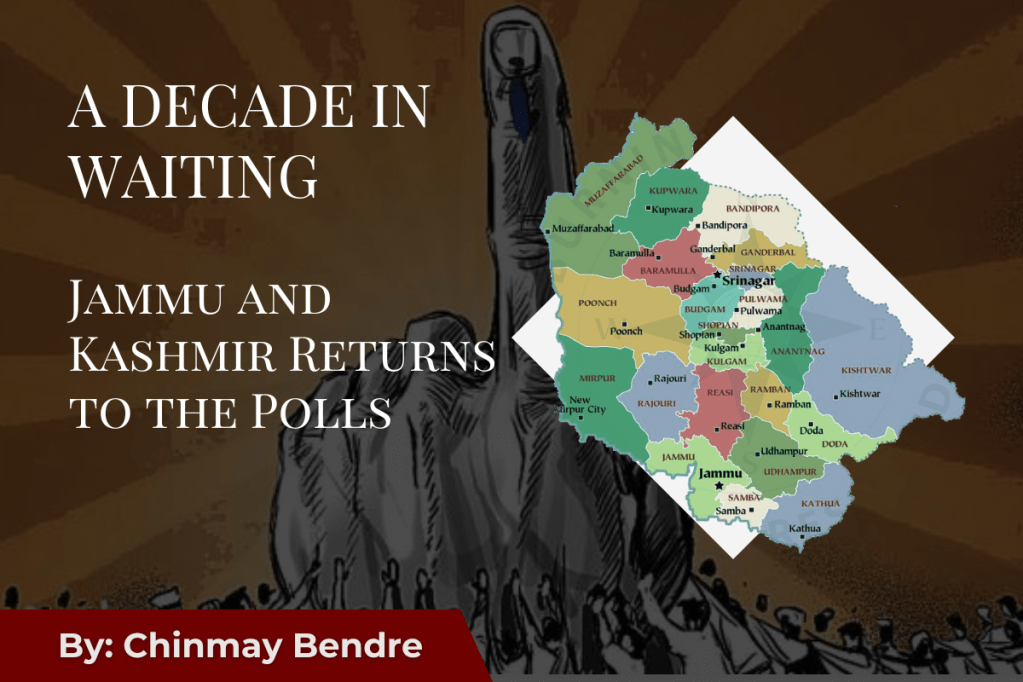
After a decade of political dormancy, the Union Territory of Jammu and Kashmir returned to the polls marking a pivotal moment in its democratic history. This long-awaited Assembly election carried profound significance both for the region and for the nation as a whole. The elections to the 90-member Jammu and Kashmir Legislature took place in 3 phases on 18th September (24 Assembly constituencies), on 25th September (26 Assembly constituencies), and on 5th October (40 Assembly constituencies).1 With a renewed sense of political engagement, the elections signaled the people’s readiness to shape their future.
| Poll Events | Phase 1 | Phase 2 | Phase 3 |
| Gazette Notification | August 20 | August 29 | September 5 |
| Last Date of Making Nominations | August 27 | September 5 | September 12 |
| Date for Scrutiny of Nominations | August 28 | September 6 | September 13 |
| Polling Date | September 18 | September 25 | October 1 |
| Counting & Declaration of Results | October 8 | October 8 | October 8 |
A New Political Landscape: Jammu & Kashmir Post-Article 370
The abrogation of Article 370 marked a turning point in the erstwhile state. The Jammu and Kashmir Reorganisation Act of 2019 brought sweeping changes, officially bifurcating the state into two Union Territories — Ladakh, and Jammu & Kashmir — on 31 October 2019.
On 5 May 2022, the Jammu and Kashmir Delimitation Commission unveiled a new political map, redrawing boundaries and renaming Assembly constituencies across the Union Territory. Under the new arrangement, the Assembly now comprises 90 seats, a change from the previous 87-seat structure, which included four seats from the Ladakh region. Of these, 47 seats are allocated to Kashmir, while 43 to Jammu.
Political Contenders in the Race:
Several political parties fiercely competed to control the 90-seat Assembly, each vying to shape the region’s future. Among the major contenders were the Jammu and Kashmir Peoples Democratic Party (JKPDP) led by Mehbooba Mufti, and the Jammu and Kashmir National Conference (JKNC), headed by Omar Abdullah. The Bharatiya Janata Party (BJP) and the Indian National Congress (INC), the latter in alliance with JKNC, were also in the fray, while new entrants like Ghulam Nabi Azad’s Democratic Progressive Azad Party (DPAP) and the Aam Aadmi Party (AAP) aimed to establish themselves in the Union Territory’s politics. Amidst this political battle, Engineer Rashid, who captured national attention earlier this year with a surprising victory over a political heavyweight, Farooq Abdullah failed to garner support.
Issues discussed throughout the Elections:
Several critical issues marked the polls, chief among them being the frequent internet shutdowns and the heavy deployment of armed forces aimed at eradicating militancy and stone pelting, even in relatively peaceful areas like Rajouri-Poonch and the Pir Panjal region. The deteriorating security situation for Kashmiri Pandits and attacks on pilgrims traveling to the Mata Vaishno Devi and Amarnath Shrines also became prominent concerns. Additionally, the significant decline in tourism, coupled with unemployment rates reaching 10.7% from April 2023 to March 2024, was frequently highlighted, with youth unemployment peaking at 18.3%, fuelling widespread frustration among the young generation.2
The union government’s failure to restore statehood to Jammu and Kashmir after the abrogation of Article 370, alongside its control of the region through the Lieutenant Governor, also became central political debate topics. The 2022 paper leak scandal involving the Jammu and Kashmir Service Selection Board (JKSSB) and the increasing contractualization of government jobs further added to the discontent.3 Lastly, the alarming rise in drug abuse among the youth was a major issue discussed throughout the elections.
Results:
The vote counting for the 90 assembly constituencies in Jammu and Kashmir concluded on October 8. The JKNC-INC alliance emerged as the leading force securing 48 seats. The BJP followed with 29 seats, while the JKPDP managed to win 3 seats. The Jammu & Kashmir People’s Conference, CPI (Marxist), and AAP each won 1 seat. Independent candidates also made their mark, winning 7 seats in total.4
Conclusion:
The long-awaited elections in Jammu and Kashmir marked a significant turning point in the region’s democratic journey post the abrogation of Article 370. With the JKNC-INC alliance emerging victorious, the results reflect a reshaping of political dynamics amidst pressing issues like unemployment, security, and statehood restoration. The outcomes signal the region’s desire for political stability and development, setting the stage for a new chapter in Jammu and Kashmir’s history.
References:
- Jammu and Kashmir Elections 2024: Key Facts. Read more at: https://www.thehindu.com/elections/jammu-and-kashmir-assembly/jammu-and-kashmir-elections-2024-key-facts-important-dates/article68626818.ece
- Ali, J. (2024). J&K’s Economic Growth Slumps After Article 370 Abrogation, Forum for Human Rights Report Finds. The Wire. Read more at: https://thewire.in/rights/jks-economic-growth-slumps-after-article-370-abrogation-forum-for-human-rights-report-finds/?mid_related_new
- JKSSB SI exam paper leak case: ED arrests another accused. Deccan Herald. Read more at: https://www.deccanherald.com/india/jharkhand/jkssb-si-exam-paper-leak-case-ed-arrests-another-accused-3101543
- Election Commission of India. Read more at: https://results.eci.gov.in/AcResultGenOct2024/partywiseresult-U08.htm



 Vidhan Bharat
Leave a comment