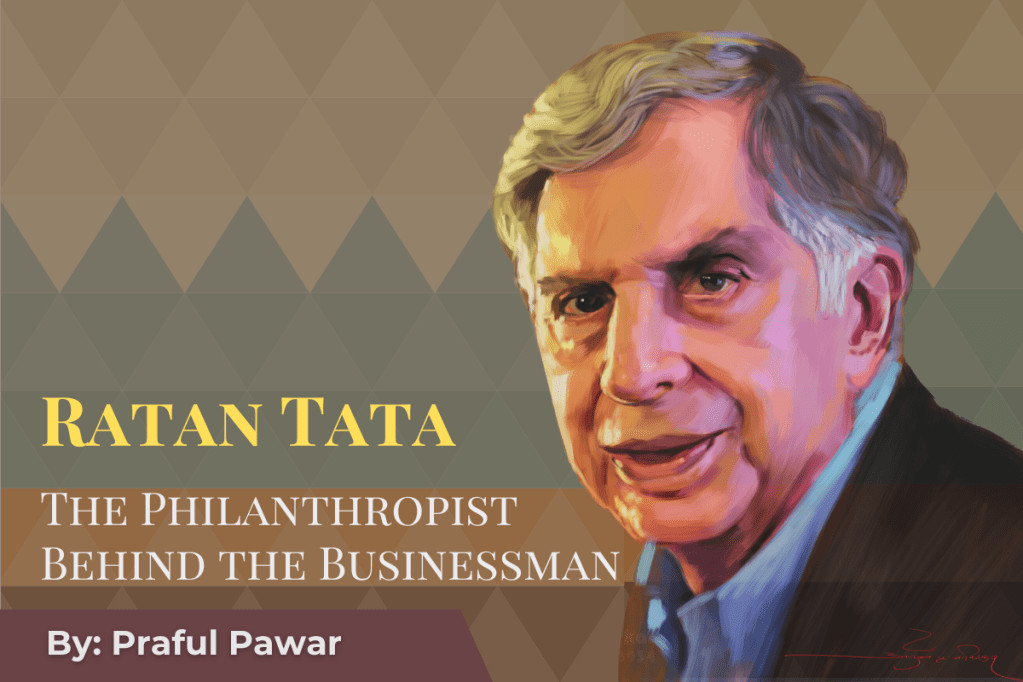
Ratan Tata, one of India’s most respected industrialists, has left a long and impactful legacy that will extend beyond the business world. Known for his humility and quiet determination, his philanthropic efforts have transformed the lives of millions both in India and around the globe. His commitment to social causes reflects the long tradition of the Tata family promoting social progress and this legacy he cherished and carried forward with deep conviction.
Efforts in Philanthropy
Under his leadership, Tata Trusts, the oldest charitable institution in India, has grown to address a wide landscape of social issues that include health, education, rural development, water sanitation hygiene, and skill development. Notably, here Tata Trusts holds close to 66% equity in Tata Sons1 and flows the dividends directly into their philanthropy work. According to the report titled “High-Impact Philanthropy: Giving Better Across Asia and the World” by The Bridgespan Group, Tata Trusts ranked the fifth largest among Asia’s 20 biggest philanthropic funders at an annualized rate of $168 million per year from 2018 to 2022.2
Healthcare Transformation
Tata Trusts have been revolutionary in healthcare under Ratan Tata’s guidance. To begin with, in 2010, the Tata Trusts donated Rs 220 crore3 to set up the Tata Medical Center in Kolkata, the most advanced facility for the treatment and research of cancer. His efforts extend to numerous mother and child health programs, mental health, and disease treatments: cancer, malaria, and tuberculosis. Testimony to his philanthropy, Tata’s personal last project was aged 86, when he launched India’s first Small Animal Hospital in Mumbai in 20234, ensuring primary health care for pets and street dogs.
Rural and Agricultural Development
Tata’s philanthropic reach also extended to rural and agricultural development through initiatives such as the Transforming Rural India Initiative (TRI). This initiative partnered with governments, NGOs, and civil society to transform areas of acute poverty. He was a benefactor to schools and hospitals built in the countryside and donated generously during times of natural calamities; above all, he demonstrated his concern for community welfare.
Response During a Crisis
Ratan Tata was famously known to be prompt in his responses when crises created a situation at large. To the victims of the 2008 Mumbai terror attack, he established the Taj Public Service Welfare Trust. Similarly, with the outbreak of the COVID-19 pandemic, he donated ₹500 crore5 to the nation to fight the pandemic. He helped the country save itself from the critical situation with much presence of mind. Mr.Tata even helped a Dalit artist when he had no means of livelihood, signed his paintings, and even offered him a cheque for his work.6
International footprint
Tata’s philanthropic moves were not confined to India. He donated $50 million to his alma mater7, the Harvard Business School, to create an executive center and two grounds being founded on the basis of education to shape the minds of future leaders. Also, he was a member of many boards, like the Board of Trustees of the University of Southern California and the Dean’s Advisory Board of Harvard Business School which portrayed a picture of global commitment towards education and well-being. The Government of India honored Tata with its second-highest civilian award, the Padma Vibhushan, in 2008.8 He was appointed Knight Grand Cross of the Most Excellent Order of the British Empire and Rockefeller Foundation conferred him with the Lifetime Achievement Award. He also received honorary doctorates from several universities in India and overseas.
A Lasting Legacy
There is a saying in Marathi, “मरावे परी कीर्ती रुपे उरावे.” which means “Good deeds remain even after death.” Ratan Tata’s life and work best describe that motto. His legacy of good deeds in the form of philanthropy and care for society will inspire generations in the long run. Through his activities, he has ensured that his contributions will be remembered long after his time is gone.
References:
- Shekhar, D. J. (2024, October 10). Remembering Ratan Tata, the philanthropist. Forbes India. Retrieved from: https://www.forbesindia.com/article/news/remembering-ratan-tata-the-philanthropist/94353/1
- Ibid. 1
- Oberoi, R. (2024, October 10). Ratan Tata: A philanthropist who touched millions of lives. Business Today. Retrieved from: https://www.businesstoday.in/latest/corporate/story/ratan-tata-a-philanthropist-who-touched-millions-of-lives-449485-2024-10-10
- Ibid. 3
- India Today. (2024, October 10). Remembering Ratan Tata, a beacon of philanthropy. Retrieved from: https://www.indiatoday.in/business/story/ratan-tata-death-mumbai-tata-group-philanthropy-investments-education-technology-steel-2614512-2024-10-10
- Pandit, V. D. (2024, October 10). When Ratan Tata reached out to a Mumbai-based poor Dalit artist. The Hindu. Retrieved from: https://www.thehindu.com/news/cities/mumbai/when-ratan-tata-reached-out-to-a-mumbai-based-poor-dalit-artist/article68741459.ece
- Ibid. 5
- Mathew, G. (2024). Ratan Tata, Farewell and Thank You. The Indian Express. Retrieved from: https://indianexpress.com/article/india/ratan-naval-tata-passes-away-beacon-of-india-inc-and-philanthropist-9612571/




 Vidhan Bharat
Leave a comment