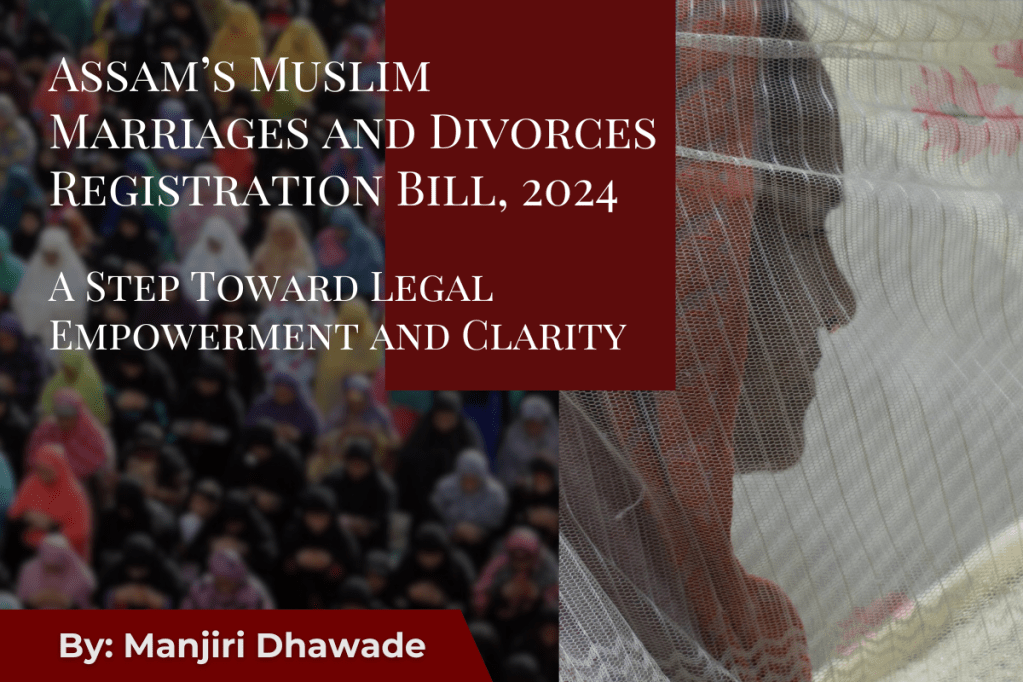
In a significant legal reform, the Assam Legislative Assembly recently passed the Muslim Marriages and Divorces Registration Bill, 2024, mandating the compulsory registration of all Muslim marriages and divorces. This landmark legislation sets a new standard for legal protection and transparency, particularly benefiting Muslim women. The bill, aimed at safeguarding women’s rights, curbing child marriages, and ensuring marital consent. This bill marks a departure from the traditional Qazi system, which has historically governed Muslim matrimonial affairs. By integrating these processes into a formal governmental system, Assam takes a progressive step toward a more equitable legal environment, empowering women and ensuring accountability.
Background and Context
India’s legal framework for marriages and divorces is diverse, with different religious groups governed by distinct personal laws. For the Muslim community, marital matters are traditionally governed by the Muslim Personal Law (Shariat) Application Act of 1937. However, unlike Hindu or Christian marriages, which are required to be registered under their respective personal laws, Muslim marriages and divorces in most Indian states have not been subject to compulsory registration. This absence of formalized documentation has often left Muslim women vulnerable, particularly in securing their rights related to inheritance, maintenance, and divorce settlements.
The lack of legal records has complicated legal proceedings, making it challenging for women to assert their rights in cases of abandonment or non-consensual divorces. Child marriages, non-consensual unions, and polygamy have persisted in some areas due to the absence of standardized registration systems. Assam’s Muslim Marriages and Divorces Registration Bill, 2024 aims to address these issues by mandating the registration of all Muslim marriages and divorces. The bill provides formal recognition of matrimonial matters, ensuring that legal rights, particularly those of women, are safeguarded.
“We are not interfering with the marriages solemnised by Islamic rituals under Muslim Personal Law at all. Our only condition is that Islam prohibited marriages will not be registered,”
– Himanta Biswa Sarma, Chief Minister of Assam
Key Provisions of the Bill
The Muslim Marriages and Divorces Registration Bill, 2024 introduces several key measures to regulate matrimonial processes within Assam’s Muslim community. The cornerstone of the bill is the mandatory registration of all Muslim marriages and divorces with designated governmental authorities. This ensures that both parties have official documentation of their marital status, which is crucial for legal protection and for pursuing claims in cases of disputes.
Another significant feature of the bill is the appointment of Designated Registrars, who will oversee the registration process and maintain secure and accessible records of registered marriages and divorces. This formal system replaces the informal Kazi system, ensuring that marriages and divorces are properly documented in line with legal requirements.
To promote compliance, the bill imposes penalties for non-compliance, including fines for individuals who fail to register their marriages or divorces within the stipulated time frame. Additionally, the bill reinforces existing legal standards on the minimum age for marriage, specifying that marriages involving individuals below 18 years for women and 21 years for men will not be recognized or registered. This is aimed at curbing child marriages and promoting marital consent.
A central focus of the bill is the protection of women’s rights. By mandating registration, the bill seeks to prevent cases where women are abandoned post-marriage without any legal recourse. Registered documentation will provide women with the necessary proof to assert their rights in cases of divorce, maintenance, and inheritance disputes.
Objectives of the Bill
The primary objective of the Muslim Marriages and Divorces Registration Bill is the empowerment of Muslim women. The bill provides women with legal documentation of their marital status, which can be used to assert their rights in legal disputes. By ensuring that marriages and divorces are formally registered, women who have been abandoned or involved in non-consensual marriages can pursue legal claims with a registered document that supports their case.
The bill also aims to increase legal transparency and protection by mandating registration. This measure will reduce fraudulent claims and ensure that both parties have a clear, legal record of their marital status. Additionally, the availability of registered documents is expected to streamline judicial processes, making it easier for courts to resolve disputes efficiently. The formalization of marriage and divorce records will ensure consistency in legal judgments related to matrimonial matters.
Another key objective of the bill is public awareness. By introducing penalties for non-compliance, the bill encourages the Muslim community to understand the importance of legal documentation in matrimonial affairs. This initiative aims to cultivate a culture of adherence to legal standards and enhance understanding of the law within the community.
Potential Impact of the Bill
The passage of the Muslim Marriages and Divorces Registration Bill is expected to have a significant impact on Assam’s Muslim community, particularly in terms of providing enhanced legal protection for women. The compulsory registration of marriages and divorces ensures that women have access to legal documentation, enabling them to assert their rights in cases of marital disputes. The bill will also serve as a safeguard against non-consensual divorces and instances where women are left without legal recourse after abandonment.
Another anticipated impact is the reduction in unregistered marriages, which often lead to legal ambiguities. By making registration mandatory, the bill ensures that individuals have a clear legal standing in matrimonial matters, protecting their rights and promoting accountability. However, while the bill is a progressive step, its successful implementation may face challenges, particularly in rural areas where access to legal services and public awareness is limited. The government will need to focus on raising awareness about the law and ensuring that designated registrars are accessible to all segments of the population.
The Assam Marriage Bill, requiring couples to register marriages within 30 days, has drawn mixed reactions. Islamic religious leaders expressed concerns, fearing it may interfere with personal laws and disproportionately impact the Muslim community and their religious freedom. Opposition leaders criticized the bill as politically motivated, suggesting it could be a tool to target minorities under the guise of reform. Civil society organizations have offered varied views—some support it as a step towards women’s empowerment and protection of their rights, while others argue that it could create additional bureaucratic hurdles, especially for marginalized communities, rather than solving key social issues. Hence, the government will need to engage with community leaders and stakeholders to ensure that the bill is seen as a legal protection measure rather than an imposition on religious practices.
Conclusion
The Muslim Marriages and Divorces Registration Bill, 2024 represents a significant step toward legal empowerment and protection for Assam’s Muslim community, particularly for women. By mandating the registration of marriages and divorces, the bill provides legal clarity, reduces ambiguities in matrimonial matters, and aligns Muslim marriage laws with broader legal standards in India. While challenges in implementation and social acceptance may arise, the bill has the potential to create a more just and equitable legal framework, ensuring that the rights of individuals, particularly women, are upheld. As Assam leads the way with this reform, it sets a precedent for other states and communities to consider similar measures for safeguarding the rights of their citizens.
Reference:
- Government of Assam. (2024). Muslim Marriages and Divorces Registration Bill.
- Muslim Personal Law (Shariat) Application Act, 1937.
- The Assam Repealing Bill, 2024.





 Vidhan Bharat
Leave a comment