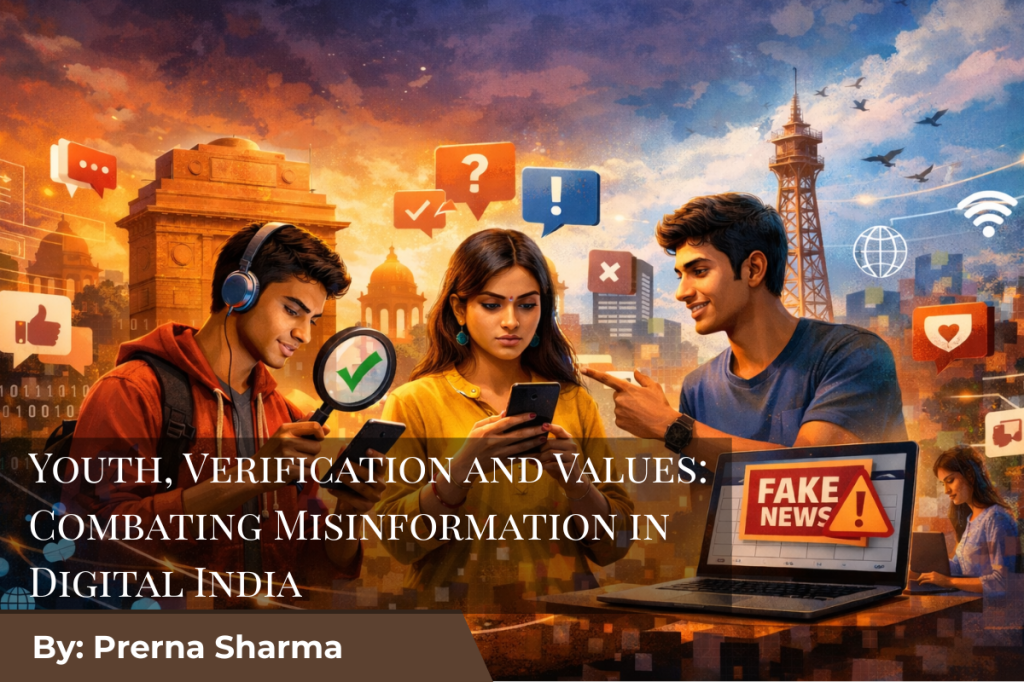
In today’s Digital India, the power of the internet touches almost every aspect of our lives. Young Indians — students, first-time voters, content creators, and professionals — are especially active online. According to a report, 83% of Indians aged 18–24 consider themselves content creators on platforms like YouTube.1 This shows how deeply the youth are shaping and consuming digital content. However, with this massive participation comes a serious challenge — misinformation. Misinformation refers to false or misleading information that spreads quickly online and can harm individuals, communities, and even democracy.
The Youth Digital Experience
Young Indians use digital platforms not only for entertainment but also for information and news. In fact, a study by Oxford University Press found that 54% of Indians turn to social media for factual information, and younger people are more likely to do so than older citizens.2 This means that right alongside opportunities for learning, there is a higher chance of encountering false content. In another survey, around 80% of first-time voters in India said they have come across fake news on social media.3 For young minds trying to form opinions on social issues, such exposure can be misleading and confusing.
How Misinformation Spreads
The spread of fake news and misleading content in India is mostly driven by social media platforms. A study showed that about 77.4% of misinformation comes from social media, with political stories making up nearly 46% of fake content shared online.4 This includes manipulated images, fake quotes, and doctored videos that seem convincing at first glance. During elections or civic debates, such misinformation can influence young voters, polarize communities, and weaken trust in democratic processes. Even sophisticated tools like deepfakes (AI-generated realistic fake videos and audio) add to the problem, as governments struggle to keep pace with technology.5 In June 2025, Karnataka proposed strict laws to penalize fake news — showing how serious the problem has become.6
Why Verification Matters
Verification is simply the process of checking whether something is true before believing or sharing it. For youth, mastering this skill is crucial. Without verification, misinformation spreads like wildfire because emotional or sensational posts go viral faster than factual ones.1 Many users do not check the original source or confirm facts before forwarding content, often unknowingly amplifying false claims. In fact, one survey found that while a large number of people believe in checking facts, only 29% really use fact-checking websites, and many still share unverified content later found to be false.7
Values and Ethical Use of Digital Platforms
In India, ethics and values like honesty, respect, and careful thinking are often taught from a young age. These values must now extend to online behavior. Before reposting something, youth should ask: “Is this true?”, “Where did this come from?”, and “Can I verify this with reliable sources?” These questions help build not only responsible digital citizens but also protect society from division and rumors.
Organisations around the world stress digital literacy — the ability to understand, analyze, and judge online content. Building strong media literacy among young people helps them recognize fake headlines, clickbait, and manipulated graphics. Educational institutions and family support are key in teaching critical thinking and media awareness.
Steps Youth Can Take to Fight Misinformation
- Check the Source: Always verify the original source. Trusted news outlets and fact-checking websites help confirm whether a story is real or false.
- Think Before Sharing: Take a moment before forwarding content to groups or timelines. Quick sharing often bypasses careful thinking.
- Use Fact-Checking Tools: Several online tools and organizations are dedicated to debunking myths and labelling fake news. Learn to use them.
- Report False Content: Most social media platforms allow users to report misleading posts. Reporting helps reduce the spread of misinformation.
- Educate Others: Share knowledge about verification with friends and family. A community that checks information together stays informed together.
Government and Society Taking Action
Recognising the threat of misinformation, Indian authorities and industry groups are promoting digital safety. For example, the Misinformation Combat Alliance (MCA) aims to encourage users to pause and question before sharing content, fostering a “truth-seeker” community.8 Government efforts also include laws and awareness campaigns to protect citizens from harmful online information.
References:
- India’s misinformation economy: need for digital literacy — Navbharat Times: https://navbharattimes.indiatimes.com/epaper/2025/nov/november16/indias-misinformation-economy-the-urgent-need-for-digital-literacy-and-critical-thinking/articleshow/125354120.cms
- 54% In India Turn To Social Media For Factual Info: OUP Study — Outlook India: https://www.outlookindia.com/national/54-in-india-turn-to-social-media-for-factual-info-oup-study-news-205362
- Around 80% first-time voters have encountered fake news on social media — Times of India: https://timesofindia.indiatimes.com/india/fake-news-on-social-media-survey/articleshow/106899024.cms
- Nearly Half Of The Fake News Stories In India Are Political: Study — NDTV: https://www.ndtv.com/india-news/nearly-half-of-the-fake-news-stories-in-india-are-political-study-7291481
- India proposes strict rules to label AI content — Reuters: https://www.reuters.com/business/media-telecom/india-proposes-strict-it-rules-labelling-deepfakes-amid-ai-misuse-2025-10-22/
- Karnataka Mis-Information And Fake News (Prohibition) Bill — Reuters: https://www.reuters.com/business/media-telecom/indian-tech-hub-state-pushes-jail-terms-fake-news-sparks-worries-2025-06-30/
- Report on fake news verification behaviours — ET Brand Equity: https://brandequity.economictimes.indiatimes.com/news/research/91-per-cent-believe-fake-news-can-influence-voting-decisions-report/110004307
- Misinformation Combat Alliance | Fight Misinformation Online — MCA India: https://www.mcaindia.in/


 Vidhan Bharat
Leave a comment